All posts by Workers BushTelegraph

Workers BushTelegraph discusses current and past events, books and film with the aim of sharing worker political education and consciousness. WBT poses 3 questions: who owns the land, workers control of production and democratic rights.

The strange case of Mohammed el Halabi

A Palestinian man jailed in Gaza by the Israeli authorities on the basis that he streamed $50 million from the Australian Government to Hamas, a organization labeled as being a terrorist group by both Israeli and Australian governments. Despite an audit by DFAT the Israelis continued to detain Mohamed el Halabi even though he has the full support of World Visions founder here in Australia, Kim Costello, the brother of the former treasurer of Australia, Peter Costello.

Nikita – Amnesty International (click CC for subtitles to overcome poor sound)

One can only conclude that Israeli authorities just pick up whom they wish and make up fictitious charges that could never be upheld in a properly constitued court of law. How does a young Palestinian man funnel money from the Australian Government to a terrorist organization? How fanciful is that?

The other aspect of this case is that it is not an isolated incident. Similar allegations were made against APHEDA (Union Aid Abroad) which had received $11 million from the Australian government and it was alleged by both right wing politicians both in Australia and Israel that Union Aid Abroad was funding Hamas instead of providing monies for agricultural projects in Gaza to grow fresh food.

Once again an audit was conducted. And despite that, the funding of Union Aid Abroad funding was pulled. This is ludicrous. This highlights the conduct of Australian, Israeli and United States governments that in concert with each other are attempting to withdraw all funding from NGOs and welfare organizations, which were set up because Palestinian land was stolen during Al Nakba in 1948. They set up these welfare organizations to assist the refugee Palestinians from their own houses.

Many Palestinians still carry the key to their residences which have been stolen by settlers under the full support of the Israeli military. So once again, we see the the colonial settler states implement illegal policies and then claim that they are not ‘failed democracies’. Full democratic rights need to be restored to the 800,000 Palestinians who have been made political prisoners in their own land since the Six Day War in 1967.

Free Free Mohamed El Halabi. Free Palestine from the river to the sea.

Ian Curr
2 April 2022

Resisting arms dealer Thales in Brisbane

Friday 25th March 2022

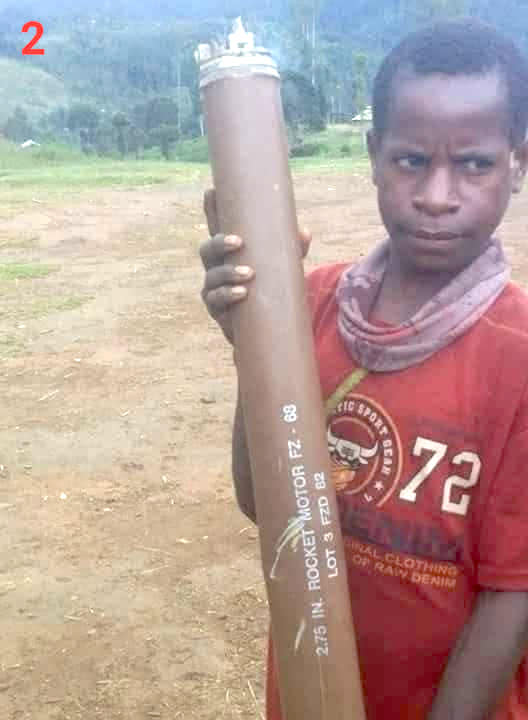
Thales rocket used by Indonesian military against West Papuans

Last Easter, a group of people from ‘Wage Peace’ went to the Thales factory/warehouse at Pinkenba. Jim Dowling was charged with “unauthorised high risk activity” for climbing on a roof and holding a banner near their large THALES sign.

Thales boasts that it is the 8th largest arms dealer in the world. They have received over a billion dollars from the Australian government since 2018.

They manufacture here in Australia Bushmaster Armoured (and armed) vehicles which they also export to Indonesia. It is known that these vehicles have been use in the killing of West Papuans.
They also manufacture bombs and bullets at their plant at Benalla.

Thanks to the Dowling family, Ciaron O’Reilly and Andy Paine for their resistance against the weapons manufacturer Thales based here in Brisbane (Meanjin). Jim Dowling had this to say outside Brisbane magistrates Court on 24 Mar 2022 :

Transcript of Interview with Jim Dowling, Ciaron O’Reilly and Franz by Andy Paine (apologies for errors in transcript … you can listen to interview on FB or on Soundcloud’s – 4PR Voice of the People.

Andy 

Welcome to ‘wage peace’ live on Facebook. We are here at the Brisbane Magistrates Court, a group of supporters and Jim Dowling here who is facing court today, for last year, disrupting Thales war machine facility here in Brisbane, up on the roof there and brought attention to what’s being done by this company in our neighboring Pacific and around the world. Jim, how are you feeling today?

Jim Dowling 

Yeah, pretty good to be standing up against the answer. It’s the thing to do. Right stuff or do stuff always merchant to death making a fortune out of war, and it’s pushing it.

Andy 

So can you tell us what happened last year? What’s brought you here?

Well, there’s a campaign against the arms trade in Brisbane last year. Quite a big campaign, they had an arms convention at the Southbank Convention Center. And before that, leading up to that we had lots of protests and different arms dealers members, the government’s giving $300 billion over 10 years to the art industry in Australia. To build it up to become one of the top 10 dealers in the world. That’s a noble goal (sarcasm). I will come out of the top 10. So we went to some of these places. We are two Thales at Pinkenba. They’vegot a factory there where they service ‘Bushmasters’. Bushmasters are armed personnel carriers which they sold a 100 to the Australian Government. They’s I’ve also sold a large number to Indonesia,  that they’ve been using them to kill West Papuans.

Jim Dowling 

So we were particularly focusing on the Indonesian connection. And there’s we’ve got pictures of rockets, which they also make, which have been used to bomb the West Papuans. So we’ve got evidence of this; Thales rockets collected by West Papuans.

And so last year, group of us went out there to their little factory and held banners and placards and I climbed on the roof and held a banner next to their to the sign saying ‘Making a killing in West Papua’ Thales.  So for that I was charged with this law called unregulated high risk activity, even though there’s absolutely no risk is very low, and there’s a fence all around the top of the roof. And anyhow, they bought in this floor to stop people have sailing off bridges and jumping and parachutes of buildings and stuff. By now they’re using against protesters, just because they can.

Jim Dowling 

So anyhow, we’re here today to continue the resistance to the arm trade, to say no to merchants of deaths. And further resisting this silly challenge. Yeah, resisting these murderous arms dealers.

Andy 

So not the first time here at the magistrate’s court resisting war, is it?

Jim Dowling 

Now there are quite a few times. Yeah, since the early 80s. Yeah.

Andy 

And what to you is the importance of doing these kinds of actions to resist war?

Jim Dowling 

Well, when I was in the WatchHouse recently, a copper said to me: “You’ll never change the world, mate”. And I used that as an opportunity quote famous quote, “I’m just making damn sure the world’s not going to change m, mate”.

 So you know, if we give up all hope, and we don’t resist violence and death making then you know, there’s not much, much of a life. We’ve got a quote on our wall and it says, Martin Luther King Jr. Says, “The day we remain silent about the things that matter, is the day we slowly die.”

So that’s why I’m here today to speak up, and to speak out about death making to do my little act of resistance in the hope that it will have an effect and every lttle act has some effect. If you’re being part of the system and not doing anything that has an effect. Not such a great effect. And if you’re resisting it having an effect as well. So I’m just doing my own resist, as we all are here today.

Andy 

All right. Anything else you want to say to the people of internet?

Jim Dowling 

Well, yeah, I got something. When Julian Assange was arrested, he’s been in custody for over 10 years in one way or another … if you ever watched the footage of him being dragged out of the Ecuadorian Embassy. We can him clearly say, “you can resist , you can resist! and I’d like to say that you can resist

Andy 

All right. Thanks, Jim. We will keep everybody on Facebook updated on how the trial guys I think I spotted Ciaron O’Reilly, he might have say a few words.

Ciaron O’Reilly 

Just reflecting on that, Jim 44 years ago when I was 17, just around the corner, when we were arrested, by the Queensland Police are expressing opposition to the mining and export of uranium, and the possibilities of nuclear war. And today, of course, we’re on the verge of a war back in Europe. And so obviously, Jim is in strife today with the courts, because in solidarity of the people in West copper, and we’re both very involved with the solidarity struggle, especially in the 90s of people in East Timor  … Timor Leste. And in the early years of that, it felt very much like this, just a handful of us. And today, of course, Timor is at least free of Indonesian military occupation. And, you know, we hope that that will be the future for West Papa.

And everything seems pretty cozy and civilized here in the center of empire. But the company is operating in this environment like Thales, create chaos and fascism, and assassination and torture and death just north of here in West Papa, it’s very hard to bring that reality into the apathy and comfort of George Street, Brisbane Australia, It is great that Jim’s kept this up for the last 44 years. And there’s an old saying that ‘the future belongs to the remnant come out of slavery’. And unfortunately, a lot of people are enslaved to consumerism and the mainstream media, not you Andy, in a kind of … a kind of zombification of civil society. Standing out here, pretty countercultural sign, trying to talk to people and engaging. Some people walking off jobs that they hate  … any questions.

Andy 

I will say we spoke about land forces last year, there’s a lot of resistance in Brisbane against the weapons trade with the land forces convention on weapons convention. And that will be on again in early October. And so if you are watching this video, and think, Hey, I don’t like war and weapons makers, then you too, can be part of the resistance … come along to ‘disrupt land forces’, it’ll be another big gathering of people trying to challenge the weapons industry and the billions of dollars of profit and the billions of dollars in government subsidies that they get, and say, keep following ‘wage peace’ or ‘disrupt land forces’ and you’ll find out the info of how you can get off your screen and come down and join in or if you’re at our place around the country, I can join in with other groups around the country, of course, lots of groups resisting the war machine. And we do need everybody … if peace is going to have a chance and we need at least as many people as there are organizing for war. And the military has very deep pockets to pay people which we don’t have. So we need the committed people to show up. We’ve got  Christine over here chatting to a bystander. Anybody else here want to have a chat to live video?

Quality supporters here, Franz does have his Papuan support group shirt on. We are here in solidarity with West Papuans people because Thales weapons, kill people all over the world and are involved in all kinds of conflicts and all kinds of dodgy deals. But for us in Australia, West Papua was very important. Franz, you want to say briefly why you think West Papa is important to stand up for?

Franz 

Yeah, well, they’re our closest neighbor. And they’ve been suffering for such a long time, you know, 60 years of persecution, invasion, still fighting for their freedom. And we not only trained the Indonesian military still who are going, persecute and kill West papuans, but we also sell them weapons. We’ve been doing that for a very long time. Weapons that are used to kill West Papuans in their own home. Our our weapons are built on this soil. So it’s a very, very important issue that not many people seem to talk about and to know much about. So yeah, I’m hoping to shine a light on

Andy
It is a war in our backyard. Only 100 kilometers from Australia’s coast. And yeah, we see so much about conflicts when the media deems them newsworthy on our news conflicts in faraway places. But the ones nearby don’t get covered. Of course, not just West Papua. We’re in the Asia Pacific region. We’ve also seen Myanma taken by a military coup and so many people have forgotten about that. We’ve had a conflictsd in the Pacific, in Fiji and all around the parts of the empire of Indonesia.

And, of course, the the mining companies that use the military to enforce their environmental destruction as well, some of these mining companies based in Australia with large arms in Australia, and they’re in West Papua, Indonesia, other parts of the world: Malaysia … using the military to enforce their destruction of our planet. And that’s the other thing that we need to call out the military for, especially as we come to face climate crisis. What role does the military play in this? Which which the answer is a lot? Anyway, that’s about it for us on Facebook Live this morning, stay tuned to ‘wage peace’. And you’ll find out how Jim goes in his trial … we are expecting him at the very least to give a very good speech in court. Plenty of experience of it and he’s never wanted to back down in the face of the legal authorities and say, it’s so important to show solidarity with those people who’ve stepped out taking a risk for peace and also to be those people … people who don’t just go along with the status quo which for so many people is so destructive, say tuning out now from ‘wage peace’, but see you at the next action.

Transcript by Ian Curr

Please correct any errors in the comments section down below.

*** STOP PRESS *** 25 march 2022

“Dear friends, once again police dropped charges for resistance to the arms trade, specifically Thales.
A small group of us vigiled outside the Brisbane court for an hour with a banner reading Put the Arms dealers on Trial and other placards. Once I got upstairs the Prosecutor informed me she would be dropping charges. A shame in some ways as I was looking forward to exposing the insidious nature of the Arms industry and its Brisbane connection, especially arming the Indonesian military to oppress West Papuans.”

Peace movement rallies outside Dutton’s Luncheon in Brisbane

I spent thirty-three years and four months in active military service, and during that period I spent most of my time being a high-class muscle man for Big Business, for Wall Street and the bankers. In short, I was a racketeer, a gangster for capitalism. – Major General Smedley D. Butler in 1931.

On 18 March 2022 outside the Hilton Hotel there was a rally for Peace organised by Just Peace while Minister for Defence, Peter Dutton, was speaking to the American Chamber of Commerce at a $2,000 luncheon inside the Hilton Hotel Brisbane. Here is what people at the rally had to say.

Here we are today, meeting gathering on Aboriginal land, land that was never seated. And we are also gathering at a venue that the defence minister, Mr. Dutton will be addressing a lunch of representatives of military corporations, military corporations, who are the ones who are really the only winners in war and militarism.

As we speak, millions of people have been displaced from their homes, in Ukraine, in Afghanistan, in Iraq, in Syria, in Yemen.

We’re meeting here today to say war is not the answer. We must, we must find another way. Because we’re on the brink of world war three. It’s a very sobering thought. And yet the escalation of militarism that’s going on around the world today can only lead us to a very, very dangerous point.

St Mary’s Choir at Peace Rally outside Brisbane Hilton

So thank you all for coming today to protest the defence minister, whipping up war and playing into the hands of the weapons corporations whose shares are going through the roof right at this moment. (Shame)

We have some great representatives of the Brisbane community here to speak today. And I’d like to start off the speaking order. With Ross Gwyther. Ross is one of the representatives from Queensland Independent and Peaceful Australia Network (IPAN), a national network of unions, faith organizations, community groups, political groups. So Ross is going to speak to you and then we’ve got about half a dozen people lined up to speak after us so welcome Ross.

Annette Brownlie
Just Peace
18 Mar 2022

__oOo__

IPAN Talk at Dutton Rally  March 18 2022

Ross Gwyther

I would like to start by expressing our solidarity with indigenous peoples of Australian in their long struggle for justice, for a treaty and for recognition of their continuing sovereignty over this land.

I would also like to express, as part of the Australian peace movement, that we stand in solidarity with the people of Ukraine and Russia. We are united in our common demands Peace in Ukraine – for Russia Out! NATO Out!

We in IPAN have called for an immediate ceasefire and genuine negotiations between Ukraine and Russia to bring peace and justice to the people of Ukraine.   The working people of Ukraine have the right to self-determination and sovereignty, to determine their country’s future.  They suffer as pawns in a proxy war between the United States, NATO and Russia.  The invasion of the Ukraine is unacceptable in international law.  And equally, we need to condemn the continued military expansion of NATO which precipitated this crisis.

Why are we gathering here today? 

Well we are here because Defence Minister and cheer-leader for war, Peter Dutton, is at a lunch function here at the Hilton Hotel.

We are here because the American Chamber of Commerce are lunching with him today.  They boast that they look for “opportunities for businesses to enter the national security supply chain or enhance their engagement across key areas including cyber, space, AI, and quantum?”

We are here because there are probably some representatives at this lunch of the five biggest big US weapons  manufacturers – like Lockheed Martin, Boeing, Raytheon, General Dynamics, Northrup Grumman.  They  together sell $200 billion worth of arms each year.

We are here because the President in Australia of the second biggest of these multinationals, Boeing, is non other than the former Defence Minister, Brendon Nelson – another cheer leader for war and destruction.

But we are also here to stop those weapons manufacturing corporations, along with the other parts of big corporate America, enmesh us in Australia even more firmly into the war fighting strategies of the United States.   The decisions that lead to that, happen not in the halls of parliament  or in Government offices. The decisions are made in the boardrooms and lunchrooms where political leaders are feted and dined by the big end of town.  This lunch at the Hilton epitomises that decision making process.

I would like to quote a famous speech by Major General Smedley D. Butler in 1931.  He was one of the most decorated Marines in American History.  He said

I spent thirty-three years and four months in active military service, and during that period I spent most of my time being a high-class muscle man for Big Business, for Wall Street and the bankers. In short, I was a racketeer, a gangster for capitalism.

I helped make Honduras right for the American fruit companies in 1903. I helped purify Nicaragua for the International Banking House of Brown Brothers in 1902–1912. I helped make Mexico and especially Tampico safe for American oil interests in 1914. I brought light to the Dominican Republic for the American sugar interests in 1916. I helped make Haiti and Cuba a decent place for the National City Bank boys to collect revenues in. I helped in the raping of half a dozen 16 Central American republics for the benefit of Wall Street.

In China in 1927 I helped see to it that Standard Oil went on its way unmolested. Looking back on it, I might have given Al Capone a few hints. The best he could do was to operate his racket in three districts. I operated on three continents.

We in Australia are being dragged into that world.  There are three different outcomes that this close connection between the Australian Government and the US weapons industry has led to:

Firstly there is an on-going campaign to demonize China.  A campaign to treat China as our enemy.  A campaign to threaten and intimidate China.  It is being led and promoted by the United States military industrial complex.  But they are using our  Australian Government and Australian people as pawns in this contention.

We know what happens to pawns.  Those of us who play chess are very aware.  Pawns are the first pieces to be moved on the chess board.  They are the first to be sacrificed.  They do not count for nearly as much as the other pieces in the “back line” of the chess board.  Our Federal Government – and it has to be said at this time the Federal ALP as well, are willing accomplices in us being used as pawns by American corporations trying desperately to stop the social and economic rise of China.   IF we continue this path, it can only end very badly.  Because it can only end in war.

The second outcome we have seen is building concrete alliances against China.   We have the QUAD alliance – Japan, India, the United States and Australia.  This alliance will add fuel to the fire of 800 US bases around the world, with close to 200 thousand US troops stationed at these bases – bases that mostly are encircling Russia and China.   Bases that have no purpose in defending the continental United States.

Now we have AUKUS – Australia, United Kingdom and United States – an agreement for Australia to obtain nuclear propelled submarines, as well as stationing more troops, ships and planes in Australia, upgrading the already considerable spying capabilities of Pine Gap and North West Cape.

The third outcome we hear just last week – Brisbane may well be a  nuclear submarine base on the east coast of Australia.   The people of Brisbane will become a prime nuclear target. 

The Quad and AUKUS agreements are imitations of NATO in the Asia Pacific.  Do we want the Asia-Pacific to be turned into a war zone of contention by big powers, constantly threatening the people and countries in this region?  Do we want Australia to be complicit in more wars of aggression?

How do we deal with these three terrible outcomes of the sorts of decisions and agreements made at lunches like the one we stand outside of now?   There is only one course that will turn this juggernaut around.  That is the course of continuing  to build a broad mass anti-war, peace movement.  We in the Independent and Peaceful Australia Network encourage to join with others in collectively building this dialog amongst the people. 

In Brisbane there are some very active and supportive member groups of IPAN – from the Quakers, to Friends of the Earth, to the Union of Australian Women, to unions such as the  MUA and  ETU, as well as many others.  If you would like to join IPAN, which now has over 50 peace, faith, community and trade unions as affiliates, come and speak to us after, and sign the contact sheet.

Together and united, we can win this struggle!. 

Ross Gwyther
IPAN
18 Mar 2022

__oOo__

Dutton luncheon rally speech – Kristin Perissinotto

I would first like to acknowledge that we are on stolen land of the Jagera and Turabul People and that their sovereignty was never ceded. The Electrical Trades Union fully supports the Uluru Statement From The Heart and an enshrined voice for First Nations in the constitution – an initiative the current government doesn’t and apparently won’t support. And the reason for this is that the Liberal National government has no regard for genuine support for the community. 

They’re focussed on fear mongering propaganda that tells their voter base that we need billions of dollars worth of military equipment instead of spending on women’s safety, community programs, support for refugees and people seeking asylum, affordable housing, and services that legitimately serve the community. 

This government doesn’t consult. This government doesn’t support. This government doesn’t ask. This government tells. Peter Dutton is in this building right now TELLING an audience about a business opportunity. He got a few tips from Scotty from Marketing and he’s talking about how much money big businesses can make through militarisation. Dutton is in there right now liaising with reps from huge corporations that manufacture military equipment. Weapons that kill and equipment that enables killing. And he’s doing that in our name. 

What he and the LNP haven’t spent any time doing is finding out  whether or not we might WANT a nuclear future, whether we want a naval base in our backyard. Peter Dutton and Scott Morrison have been warning us about uncertainty in the region and increased risk, going back to the old Liberal playbook and using the catch cry of national security – but they won’t talk about the increased risk that nuclear poses.

They want to talk about the jobs the proposed naval base will provide, but they won’t talk about who will get those jobs, they won’t talk about how many jobs it will be, and they won’t talk about which businesses will benefit from the base. 

They’ll put fear in us about a vague threat of ‘China’ without providing any context or genuine information. They’ll tell us that riding on the coattails of the US will protect us, but they won’t say from what. The term ‘national security’ has been said so many times that Peter Dutton is probably muttering it in his sleep. It’s a marketing phrase – an election cry. It’s not a promise or a commitment, far from it. 

Because when the Libs talk about national security, they’re talking about keeping refugees out. People who have been displaced from what they deem the ‘unwelcome’ countries like Afghanistan. The ongoing terror in Afghanistan is just one example of Australia’s alliance with the US in action. We have blood on our hands when it comes to the lost lives of innocent Afghan people. And the government dragged its feet when it came to accepting refugees. 

When the Libs talk about national security, they’re talking about deporting visa holders who have been jailed due to traffic violations. Visa holders who haven’t lived in their home countries since they were children have been sent back to a strange land after being released from prison. First Nations People have been among the 4000 people deported by this government, many while Peter Dutton was at the helm.

When the Libs talk about national security, they are ignoring the real insecurity faced by Australians. Families who have no home. People who have to choose between putting petrol in their cars or food on the table. Workers who’ve had no choice but to work for exploitative labour hire companies, often working for less than the employee beside them. Sometimes unable to qualify for a home loan due to their insecure employment. These companies can fire workers with an hour’s notice. The LNP MADE that possible with the Building Code. The LNP has enabled insecurity. 

And the biggest insecurity of all: the climate. The LNP have made no genuine moves toward climate action in this country. The government continues to increase the spend on military equipment, but has dedicated very little to climate action and a renewable future.

Dutton and his LNP cronies are capitalising on Russia’s invasion of Ukraine to pedal propaganda about securing our country. There are so many layers to unpack about how disturbing this is, but I’ll just focus on one.

It’s been very  interesting, watching the manner in which our government reacts to the invasion of Ukraine. It’s a horrific thing of course, and every unionist stands in solidarity with the people of Ukraine. But where is this outpouring from the government in relation to ongoing wars in other countries? I mentioned Afghanistan earlier – how quickly did that disappear from our news cycle? How quickly did that drop off the agenda of taking points from the prime minister? How often has the occupation of Palestine been in mainstream media since 1967, the first year of the aphartied? All we’ve heard in months is a vague tweet from Scott Morrison’s media advisor about the warm phonecall he had with the Israeli leader. 

Where’s the outrage when a country of people who are not christian, who are not white, live in terror and war? The people of Ukraine who look and live like many of us are given support, sympathy, and resources. The refugees from countries in the Middle East are criminalised for exercising their legal right to seek asylum in what they think is going to be a welcoming and multicultural country. 

War is fodder for this government. A marketing tactic. A sales opportunity for big businesses. A dog whistle for white nationalist voters. This government doesn’t care about security – national or otherwise. They care about winning an election. And the next one, and the next one. 

Kristin Perisonotto
ETU
18 Mar 2022

Empire of Lies

Interview with Ukrainian Greek Catholic priest, Martin Arnold, on war in Ukraine.

SPEAKERS

Martin Arnold (Ukrainian Greek Catholic priest),
Ian Curr (4PR – Voice of the People).

Ian Curr 

Can you please introduce yourself?

Martin Arnold 

Good day. I’m Martin Arnold. I’m a Ukrainian Greek Catholic priest. And I’m very concerned about what I would call Ukraine’s Kremlin problem. I could talk to you inexpertly, but at length, about things from 1721 to 1990. But I and the listener are more concerned about current issues in Ukraine.

Ian Curr 

Before we get into those current issues, could you tell our listeners a little bit about your association with Ukraine?

Martin Arnold

Well, I met up at Coorparoo state school in grade six with a Ukrainian lad, not knowing the Ukrainian language, Ukrainian religion. We are still friends Marko Pavlyshyn and I after all these years, and eventually, at a time when the Ukrainian Greek Catholic Church was short of priests, they would say, I became a Ukrainian, Greek Catholic priest. And for a long time, until 2008. In fact, I would explain to everybody almost straight away that although I’m a Ukrainian Greek Catholic priest, I’m a Queenslander and with with German ancestors and English, and Scottish.

Martin Arnold 

Q. Is Putin the unilateral source of aggression in Ukraine?

Martin Arnold 

I would say that the Putin government has wanted to destabilize the Ukrainian government, and increase its sphere of influence throughout what it describes as the former Soviet Union. I think there are a few people, Ukrainians, who are sympathetic; I suppose Yanukovych would be the name that springs to mind. But yes, I guess, the great bulk of the   … I’m sorry, what was the term you used?  Aggression?

Ian Curr 

‘(Was) Putin the unilateral source of the aggression in Ukraine?’

And when you said Yanukovych you’re talking about a former president of Ukraine?

Martin Arnold 

 I am. Yanukovych was  President of Ukraine until 2008 (2014 sic), I think when he left Kyiv in response to large public protests about his government’s refusal to implement an act of concord with the European Union; not to become part of the European Union, but just to become a corporate cooperating member, which people saw as an opposition to it if people increasingly saw this as an attempt to keep Ukraine within the Russian sphere of influence, which before Putin came to power was not I think that was particularly objected to be (a) crying wish to be independent, but it had traditional ties with Russia, but Putin’s government has been ‘revanchist‘ (= one who advocates or fights for the recovery of lost territory or status).

Ian Curr 

You mentioned there, that the European Union is heavily dependent on Russia for energy. So 46% of its coal and uranium comes from Russia. 41% of its gas (comes from RF), and 27% is oil that comes from Russian Federation.

So why would the EU want to antagonize Russia?

Martin Arnold 

Well, it doesn’t. Like Ukraine, the European Union hopes for peace, hopes to avoid  Russian Federation invasion. And, indeed, this has been a cause for, perhaps, increased the hesitance of Berlin and Paris governments from being as enthusiastic as they might be about Ukrainian independence. But it seems to me that it would be a good thing for the Greens in Europe to make a political decision and to say about energy sources and to say, oil and gas from the Russian Federation, we need to replace that with green energy as soon as possible.

Ian Curr 

Well on that, war is a great waster of fossil fuels. So that’s one reason why a war should be the last thing on the agenda, because it would mean a terrible waste of fossil fuels.

Now, when you say that the EU doesn’t wish to antagonize Russia, in the last 30 years, NATO, the North Atlantic Treaty Organization, which comprises European states, they have advanced 800 miles (1300 kms) towards the Russian border in the last 30 years since the downfall of the Soviet Union.

So isn’t that an aggression?

Martin Arnold 

Let me try to answer indirectly first, I think that Mr. Putin’s raising of this demand that Ukraine should never become a member of NATO, at this time, is a bit of a furphy. The Ukrainian or Georgian membership of NATO in the near future is not on the line. NATO is very hesitant about accepting Ukraine or Georgia as a member of NATO because of the very fact that they are involved in this dispute. There is already so yes, the NATO has not expanded in the last what 15 years, and is not likely to do so in the near future. So for Putin to demand that NATO’s should renounce its its constitution, which allows other people to join this. You know what it said? A mutual defense pact is asking we as I leave the listener to think for is does that indirect answer to some extent your cover the question?

Ian Curr 

(Perhaps) We can get more into it through this means: In 2015, the there were a number of parties to the Minsk agreement. And that was in response to the fact that in 2014, there was a real crisis in Ukraine. And the parties (were) Germany, France, Russia, and Ukraine. Now, what is the US and the UK doing by constantly talking up the conflict? You know, we’ve had, really, by any measure, a whole deluge since last October (2021), where there’s this talking about the amassing of troops on the Russian and Ukraine border. And we’re hearing all about talk, and it’s coming from the United States, security organizations, it’s coming in the UK, through the most mainstream publications, even the the London Review of Books (Did I invade? Do you exist? James Meek) is talking it up. So surely, the parties to the dispute? You know, under the Minsk agreement, surely they should be the ones who sought out the problem?

Martin Arnold 

The Minsk agreements were an attempt to seek peace in what most Ukrainians and their government would say would be a de facto Russian occupation of parts of Luhansk and Donetsk Oblast. So the

Ian Curr 

This is in the South and the Southeast, is that right?

Martin Arnold 

In the east, yes. They’re part of the highly industrialized part of Ukraine. And in 2014, there was talk amongst people of Luhansk and Donetsk about, you know, perhaps we would do better as an autonomous region of Ukraine rather than rather than as a full member or an ordinary member of the Ukrainian Federation. But my understanding is that amongst the people of Luhansk and Donetsk, who are not in the occupied zones portions are amongst the most patriotic in the country. They see the the the incursion as (being) on their land! That this is not a an attempt to free the people of Donetsk and Luhansk from oppression but an attempt to incorporate them effectively in the Russian Federation.

Ian Curr 

Why would Putin mobilize a vast force on the border of Russia and Ukraine out of the blue?

Martin Arnold 

It was connected with his demand that Ukraine should never join NATO  … should agree never to joining NATO. It I think that the purpose of but, to some extent, I guess this this was a military exercise, its troops want to have a military exercise, but it’s a military exercise in such a way that it could involve all sorts of invasion of the other country, annexed country rather than a military exercise around Moscow, say, for example, which would not immediately involve invasion of another country. Sorry, I’ve lost my train of thought. …

Ian Curr 

In 2021, which is the date you remember, there was an operation called ‘Defender Spring’, conducted by the United States and NATO, involving 28,000 troops in coordination with US naval operations in the Black Sea, which is to the south of the Crimea. And, of course, for the Russians, the Black Sea is absolutely a core strategic interest, because it provides them with southern warm water ports. From the Soviet Union on Russia has always had a very major interest in that area. So the NATO can, and the US conducted these exercises around the Black Sea. So maybe that is one reason why Putin would come out and start doing his own exercises in his own country, you know, like he is not conducting these exercises inside Ukraine. However, the US and NATO have conducted exercises in the Crimea, and in part of Ukraine itself. So what I’m really getting at is here is… Is the expansion of NATO non-negotiable?

Martin Arnold 

Ukrainians would still dearly love to be a neutral state. However, as Putin’s aggression continues, they and their government have lost faith in Putin’s intention, assurances that he does not intend to invade Ukraine or to annex Ukraine or to annex parts of Ukraine any more than he has already done. I should say that the Black Sea is also a strategic great strategic interest to the Ukrainian government. Like part of the the difficulty of the RF’s  occupation of Crimea is that it now has forces on both sides of the main waterway of Ukraine. So it has been imperative to from the Ukrainian government’s point of view for freedom of shipping through these through this strait which previously, which previously … this some river mouth, I should say.

Ian Curr 

So when you say, occupation of Crimea,  section of the Crimea was gifted by the Ukrainian government to the Russian Federation under a lease arrangement. So both strategic interests, that of Russia and of Ukraine were protected there.

Martin Arnold 

No, no, I wouldn’t put it that way…. In the 1990s, the Ukrainian government hoped for a peace dividend. And it renounced the use of nuclear weapons in return from an agreement from the Russian Federation, and other states that they would respect Ukrainian integrity and sovereignty. There was also an old, quite big Soviet naval base in Crimea.  Ukraine found itself in possession of this naval base, which it didn’t want, wish to spend money on, on maintaining. And for that reason, it leased it to the Russian Federation, which did I, I’m sure we deeply regret that decision. Lau but of course, this was in the time of before, before Putin came to power, good relations with the Russian Federation. Yeah, I guess that answers the question to

Ian Curr 

The Ukrainian economy was very strongly reliant upon the Russians because, for example, nearly 50% of all of its electricity needs came from the old Soviet nuclear power plants. And then, I think, in 2008, the Ukrainian government signed an agreement with Westinghouse for their plants to be supplied by uranium, and for them to be upgraded. That then alleviated their dependence upon Russia for electricity.

And so that you can see that there was an attempt to break free of any kind of dependence on the Russian Federation. But Ukraine is dependent on the Russian Federation, as is Europe, because at the moment, most of the energy supplies that feed Europe comes through Ukraine. And of course, the Russians have been trying to overcome that by sending gas down through the Baltic Sea. But that that hasn’t been completed yet. So still, the Ukrainian state is very dependent upon both Russia and the European countries for royalty payments. So it can’t just isolate itself without looking at these economic realities is what I’m saying. So a lot of the moves that are being made, some of them may be clumsy, but they’re response to the hard reality of economic times. On the most part, the people are very poor, even though they’re quite an advanced country. They have actually mentioned a lot of heavy industry, from the old Soviet days. So there’s peaceful things that are being done, which could be upset if Ukraine makes a wrong move, so to speak. And that’s why I asked the question about NATO expansion, is that, you know, the sovereignty of Ukraine is not just dependent upon the Kremlin. And what it does, it’s also dependent upon what NATO and the United States does. So you know, it’s a tricky situation for the Ukrainian government to be in.

Martin Arnold 

Yes. One commentator thought that the best response Kiev and NATO could have given to his (Putin’s) demand that Ukraine never join NATO would be to decline to answer. Practically. This is not on the cards for the moment and leaping ahead, I think the economic situation … I’m not an economist. But I imagine that the best thing that NATO could do for Ukraine is to say, to say not in response to Mr. Putin demands, but generally that there are no plans at the moment for any countries to join NATO further. And for the European this thing the European Union could do would be to say, well, we will accelerate attempts to integrate Ukraine into the European Union. I think this would have this would have a greater deterrent effect on the Soviet … I guess, I don’t know quite why I think this, I somehow suspect this would have a greater deterrent effect on Mr. Putin’s invading Ukraine, then Ukraine being put on the list to join NATO.

Ian Curr 

Okay, now, that ends my series of questions relating to the Tariq Ali essay. Now, I have some of my own questions that I’m very curious about in the second half of this interview.

The State of Israel is a sort of a natural ally of Ukraine. But there is a real contradiction in that, because, before the second world war during the Second World War, and afterwards, there has been a strong anti-Semitic sentiment in Ukraine. And so, if Israel comes out now and supports the US and NATO and says, Look, we’re going to oppose Putin. It gets caught in this bind. It’s, it’s supporting a country, which is one of has one of the worst records of anti-Semitism in the world.

Martin Arnold  

How do you measure one of the worst records of anti-semitism in the world?

Ian Curr 

They helped kill Jewish people

Martin Arnold 

it’s a sort of a rhetorical question. Ukraine certainly had a larger proportion of Jewish residents than Russia. I don’t know if Ukrainian anti-semitism was worse or more than anti-semitism amongst Russians or Poles or Germans, or at least those Germans who sympathize with Hitler …

Ian Curr 

Well, I say it expressed itself in World War Two by Ukraine being divided in that a section of the country supported Hitler against the Ukrainians that didn’t want to have any part of fascism.

Martin Arnold 

You’re perhaps thinking of Stepan Bandera’s government as you speak about this?

Ian Curr 

I’m not talking about the government, I’m talking about the people. Of course, you would expect Russian people of Russian culture language to be anti-fascist. And the reason why they’re anti-fascist is because of their experience during the Second World War, where they lost over 22 million people. So you would expect that …

Martin Arnold 

Ukraine, I think suffered worse than Russia. In terms of deaths in this second World War, the Jewish population was almost eradicated. The fighting happened more on Ukrainian territory than on Russian territory. That’s one observation

Ian Curr 

There is a slight anomaly in what you’re saying there in that Ukraine was part of the Soviet Union then. So the, the Nazi forces were fighting on Ukrainian territory, they were fighting the communists led by Stalin. So you know, that’s that that was the situation and, you know, they lost a lot of people.

Martin Arnold 

Yeah, but you we’ve, this is part of part of, I guess, a kind of trick that goes back before even Putin, you know, to assimilate Russia with the Soviet Union. So, the Soviet Union is, according to its constitution … this federation of republics … It suited Russian dominance of the Soviet Union to allow people in the West to say, instead of the Soviet Union to say, Russia, our great ally Russia, in in the fight against fascism …

Ian Curr 

but we shouldn’t forget that in the Soviet bloc … Okay. Russia was the largest … but Ukraine was the second largest, by far.

Martin Arnold 

Well, yeah. And that’s why I’m saying that it suffered hugely, worse than Russia in the Second World War. I have read accounts of outrageous behavior by Ukrainians. I have read accounts of some Ukrainians also thinking that the Nazis might be better than the Stalinists. And soon changing their mind by and large, after they encountered the Nazis, because in the Slavic countries, it rapidly became obvious that the Nazis regarded the Slavic peoples as second class citizens. They weren’t non-people like Jews and Gypsies. But they were subject people and what, so no Pole, no Ukrainian, none of the Slavic peoples was enamored of this kind of arrangement.

Ian Curr 

There has been a historical divide in Ukraine between the West and Central areas, and which tend to be more nationalistic, and the east and southeast, the Donbass regions, which are Russian speaking and more sympathetic to (the) Russians.  So, It you know, when you talk about the Ukrainian people, you often refer to it as sort of just one block. But, you know, like in every population, there’s a lot of diversity and it’s very marked regionally. And if you look at the elections from 2000 onwards, you’ll see that if the government in Kyiv is sympathetic to Russian Federation, you get the people in the Donbass region tend to vote for it. And the people in the in the central and the western area, they vote against it. And so, you know, you get that difference of opinion within Ukraine itself. So what I’m maybe suggesting is that Ukraine crisis is not a NATO, US, Russian crisis at all. It’s a Ukraine crisis, where there’s a civil war going on within the country.

Martin Arnold 

Ukraine since well, since it achieved independence, really, for the first time since 1750. In in 1990, has strenuously adopted a policy that those who live in Ukraine are Ukrainians. In one sense of course, there are Ukrainians who speak Ukrainian fluently. There are Ukrainians who speak Ukrainian occasionally, there are Ukrainians who don’t speak Ukrainian at all. In this respect, perhaps you could see an analogy with Ireland, you know, there are lots of Irish people, I think, who are pretty weak on this command of Irish. No more or less Irish for that. In terms of ethnicity, you know, there are there are Tartars there are people who say I’m just Ukrainian. There are people who say, I’m mostly Russian, but I have a Ukrainian grandmother, or people who say I’m Jewish people who say, people identify in various ways within Ukraine as different having different ethnicities. I don’t think that people in eastern Ukraine …. Well, I would, I would bet my bottom dollar that people in Western Ukraine do not wish to become part of Putin’s Russian Federation. if faced with a choice of that, or identification with the European Union, they would choose the latter. But yeah, Eastern or Western. Ukrainians would like to have close relations with all their neighbors. It just seems difficult at the moment with the Russian Federation.

Ian Curr 

You’re a priest, the Ukrainian priest and your parishes in the area of Wooloongabba. And I remember when the Gabba before the South East freeway was erected, and it had a strong Russian and Ukrainian presence in that. And a lot of the culture of that area was wrapped up in that … I remember and to this day, there’s, you have the Russian Hall there. And there have been a number of Russian, Ukrainian and Serbian churches in that whole area. And even so, the freeway even though it divided the community, it still was not totally successful in doing that. Now, in your own parish, of course, a war in Ukraine would have a devastating effect on the people, your parishioners. And what are the sentiments that you’re getting from them about the current crisis? Is it similar to what the Ukrainian government is saying where it’s saying that? Look, it’s it’s not such a big deal. We’ve lived with this for a long time. We think that that some of the pundits have overreacted, the President came out recently and even said we think talking up this crisis is not a very good thing for our country because … we’re losing billions of dollars, is it? So what’s the on the ground? What are the people saying?

Martin Arnold 

They’re concerned about their relatives in Ukraine. They’re concerned for the for the future .. concerned to try to have a resolution … yes, there is a kind of weariness I said somewhere recently, people are horrified at this further annexation of or occupation of these regions … official occupation of these parts of Donbass and Donetsk, I amended it to horrified isn’t quite the right word. Even people in Ukraine and even people like me, in you know, living outside Ukraine have been living with Putin’s. Irritation of Ukraine with occasional rises into actual aggression since after the first five or six years of his being in office, and so we’re not horrified. Exactly. We’re just saddened. And, yes, hope, hope for two to play our cards right, that our government can negotiate for the best result under the circumstances.

Ian Curr 

Recently, a group called the independent and peaceful Australian network sent an open letter to both the defense minister pain and to the Prime Minister Scott Morrison, besieging them with de with a very close relationship that they have with the secretary of state from the United States is was visited recently with the Prime Minister of the of the UK, beseech them to make a call for peace. And they itemize some of the things that they want to see happen. Number one, the Minsk agreement, it should be worked out amongst the parties to the Minsk agreement in 2015. They say on no account, should there be any talk of nuclear weapons being used? They should put that off the table completely. That, that basically, they that in that in that letter, they’re trying to get the Prime Minister to rather than he and his defense minister, gotten to try to get them to tone down the rhetoric and to use their close relationships with these other with the United States and Britain to try to get them to tone down their rhetoric. Would you now, over 400 people have already signed that letter? Would you support a letter like that?

Martin Arnold 

I am. I think generally speaking, the it is unhelpful for defense ministers of third party countries, countries that are not well even countries which are connected your data to make statements on Foreign Relations, they should leave this to their foreign ministers and premiers. The I suppose I’d like to speak a little bit about the Minsk agreement by by recognizing these little parts of Luhansk these parts of Luhansk and Donetsk that are occupied by Russian Federation sympathizers If you could put it that way. And now actually, with Russian troops officially present in them. Mr. Putin has brought the Minsk accords to an end because the process of the Minsk accords was for our forces to withdraw from Luhansk and Donetsk and for the government in the key of government to arrange elections for an assembly which might vote for autonomy within the within Ukraine. That’s now come to an end. But yes, Ukraine looks for the support of, especially the large players in the North Atlantic and Europe. Berlin, Paris, London and Washington. And yes, certainly Ukraine. Yes, we certainly would welcome Mr. Blinken, Mr. Biden, prefacing all their statements with, of course, the NATO hopes for peace, as this would that this would be this will be, I think, an improvement of their rhetoric.

Ian Curr 

Just in closing, now, I’d like you to comment on the really broad issues here, rather than focusing just on Ukraine, because it’s, you know, no country is in isolation. Is it possible that what we’re witnessing is the decline of a great empire. And that empire is that of the United States. And the reason why there is that decline is because the economic powerhouses of the world now have shifted from the west to the east. The Chinese economy now is at least twice as large as the United States. Both it and the countries that surround it, that are engaged in that economic revolution, almost, that all the focus is moving from Europe to Asia. And so really, what we’re witnessing here is a rather unusual thing for a country such as our own, where we have fought and died in wars in Europe. And that will never happen again, Australia will never again, commit troops to a war in Europe. It’s because we’re not within the economic sphere. It’s not as important to us as Asia. So is it possible that this is really a total furphy, this crisis? You know, people saying there’s a possibility of another big war. Maybe it is a total furphy because the United States will never commit to defending Ukraine, and nor will the major economic giants of Europe because they are so dependent upon Russia for their energy.

Martin Arnold 

Well, to respond to the second part, first. Give me a moment to think. I suppose, responding again, indirectly. I gather from BBC World Service that Mr. Putin has now upped his call from asking that Ukraine should renounce joining NATO ever to Ukraine in addition becoming demilitarized. I leave it to the listener whether to think whether If Ukraine were to renounce not only its nuclear weapons, but all its armed forces, whether the Russian Federation would respect this and say, Oh, well, yes, of course, now we have a neutral Ukraine, which has no weapons, we will of course not, not take any more interest in its internal affairs.

Ian Curr 

From Putin’s point of view, that’s the logical thing to say, because it’s forever insisted that NATO not expand the east and that they, they wanted these buffer states, which they, because of Putin’s own incompetence, and the incompetence of Boris Yeltsin, in particular, they allowed NATO to move those 800 miles east, and, as you pointed out, even make states on their border members of NATO, you know, Latvia and Lithuania …

Martin Arnold 

the Russian television to Russia today. I just noticed yesterday on its website has a category there are two categories stood out to my attention. One was Russia and the post-Soviet space, and the second was: the world. It’s not an accident that Latvia, Lithuania and Estonia are amongst the staunchest supporters of Ukrainian independence. They know and Georgia for that matter, they know that there are people in the Putin himself, perhaps there are people in the Putin entourage who think that all of the old Soviet country should be in control in either alliance as a client state or in the direct control of Moscow.

Ian Curr 

Just a caution there about the accuracy of the BBC,  the BBC is not averse to politicizing it’s news service and commentary (mentions the invasion of Southern Ossetia). So you got to be pretty careful.

Martin Arnold 

Well, yes. I would like to speak to my friend Marco about the matter, you raise your speaking of the, at the 2014 15 agitation. But if these were Georgian fruits, I feel sure that they came under the inspiration of the Russian Federation.  George, you

Ian Curr 

But you just said Georgia supported Ukrainian independence.

Martin Arnold 

Well, I think that the, I guess I was speaking inaccurately, but I think the Georgian Government is having its own difficulties with the Russian Federation. It is, I can’t imagine it would say believe that if Putin got Ukraine, he would then give up on his his designs on Georgia. Hmm. But yeah …

Ian Curr 

It was the birthplace of Stalin.

Martin Arnold 

But to true to your general question, yeah.

Ian Curr 

Decline of empire.

Martin Arnold 

Yes. I wish I could conjure up the details. But I was talking to an economist friend by Michael Kennedy. The other day. And if I’m remembering his impression correctly, you know that the the per capita GDP in China is not is quite a bit less than per capita GDP in in the United States. Because it’s such a big population that it is it is. Has this enormous GDP which is a significant thing in itself, hey, but

Ian Curr 

Well, the economic miracle of China is that it took peasants who were terribly poor in the space of a couple of generations. It took them from a per capita income, you know, very low into, I think it’s now about 20,000. US dollars, whereas the per capita income of the United States is above 50 … to go from poverty, to, you know, to, to that level of income, in the space of a generation or two, is a remarkable achievement for the Chinese to get that. And so, and who’s to say that it won’t continue?

Martin Arnold 

Well, Michael Kennedy, perhaps you should have an interview with Michael, if you could, because he points out that, that many countries have gone through this cycle of transfer or from subsistence of subsistence laborers becoming involved in industrial, secondary industry labor. And there’s usually a point where this slows down quite, quite dramatically.

Ian Curr 

Of course, China is a capitalist country, it is dependent upon them going from industrial to tertiary (development). And that they have done that, you know, they have moved into that area of, you know, where they are really a powerhouse in the computing world, for example. They manufacture a lot of, not just hardware, they manufacture a lot of software as well. So and they it with their belt and road projects, to places like Kazakhstan, and places. You know, the road West, for China, the heavy industry is going to be in those in the ‘Stan’ countries, and they’re trying to go to the tertiary level of, of capitalist industrial progress. So that yes, yeah. So they’re going beyond what Michael’s saying they’re not, they’re no longer just going from subsistence to industrial. They they’ve gone past that.

Martin Arnold 

Well, yes. Perhaps you wouldn’t want to use this portion of the interview? Because I’ve been? Yeah, I agree with in the sense that I think China is a great superpower, hey, now. And in the period from 1990, until now, it seemed that the United States was the pre-eminent great superpower. That Germany, Britain, France, the EU, collectively, were was a was up a big economic unit, but didn’t have the, as a military and industrial center didn’t have the pre-eminence of the United States. And well, I don’t think it is a good thing that the Xi government is challenging, flat, free evidence. But I think it’s a good thing, that the United States is not pre evident on its own. It’s a good thing for well, it’s destabilizing for the world. But it’s a good thing for the world.

Ian Curr 

Well, given the shift. I think that it’s insane for the United States or NATO, to die on a hill in Ukraine, especially given the fact that they need Russia, Russia is where the Europe, Europeans get their energy from if they want to compete economically, with China, which is what they’re trying to do. They need Russia, they should not be looking for reasons to get into a fight with the Russian Federation.

Martin Arnold 

So far. This part I would include in the interview … so far the Ukrainian government, the key of government has not asked for any apart from minor, you know, troops, advisory kind of troops. Any foreign support. The President has used the phrase we will provide the boots on the ground. So, at the moment, there is a no requests from the Ukrainian government for any other any other government to actually provide troops for Ukraine?

Ian Curr 

Well, that’s an argument you’d have to take up with Tariq Ali, because he says that the US and Great Britain and NATO are supplying arms to Ukraine.

Martin Arnold 

Oh, yes. But we asked for support. Mostly, we have to buy them. But, yes, we’re willing to take that risk. But as for you know, we are hoping that by maintaining the possibility of a credible resistance, even if not an over an unsuccessful resistance to a major Russian invasion, by the fact that the occupation would be fiercely contested by the people. That and by the threat of economic sanctions by the West. The Russian Federation would hold off from any major incursion … that’s out.

Ian Curr 

Well, it would wreck the country.  Is there anything else you’d like to add? Martin?

Martin Arnold 

I’d like to thank you for your effort in trying to get me to order my thoughts a little bit on this matter.

Ian Curr 

Well, I’ve gone from knowing virtually nothing about Ukraine, only about Chernobyl is all I knew to to you know, really two weeks of study in the period of preparing for this interview, I’ve learned a lot and it’s a lot to be sympathetic to the people both at home in Ukraine and also here in the Wooloongabba. They, you know, hopefully it will not come to a war.

Martin Arnold 

Yes, yes, indeed.
War intervened …

The University of Queensland’s unambiguous support for the military industrial complex since the 1970s is still apparent 50 years later in the 2020s. On Wednesday 16 February, during O-week, a local group, Wage Peace, disrupted the UQ’s engineering department. However the rest of the campus was business as usual with corporate tents filling the area between the Main building and Sir Fred Schonell drive. Rock riffs pealed off across the sporting oval as students safely made the transition from high school to tertiary education.

In the early 1970s UQ students and staff responded by joining the anti-war movement outside the University and participated in the Vietnam Moratorium Campaign. The University regiment headquarters were raided and files of new CMF soldiers destroyed. Someone tried to firebomb DuPont offices in nearby Toowong.

As the threat of new wars mount in the Ukraine and the South China sea and old one continue in neighbouring West Papua student disregard for these worrying events was evident. Refugee Solidarity Meanjin leaflets were tossed carelessly on the ground near the Admin building.

Yet, down in one of the engineering buildings, Wage Peace led by Margie, Larysa, Christine, Miriam and the crew held a two hour long lecture and tutorial on the truth of weapons companies’ involvement in universities. Their message was that State Capture was repurposing of the University into an institution which serves the military industrial complex.

The Engineering school at UQ always provided the most hostility to our marches in the 1970s. The Engineering students would throw water bombs at us from the Prentice Building. Perhaps those students grew up and became Professors who support the Boeing Corporation? I don’t know.

Boeing attack-helicopters are in West Papua shooting at farms and towns. The group states that Boeing just sold $40bn worth of jets to Indonesia.

“It’s not too hard to disrupt: just a foot in the door; ex-students (alumni), students with friends” – a spokesperson said, perhaps hopeful that others may follow.

It is too early to tell but there is no evidence of this, yet.

Song
Cuan Durkin and Allie Sherlock sing ‘When we were young’.

Thanks to #WagePeace #RadicalTimes

Street Marches 1967 – 1977

This film is a record of street marches that were banned by successive Queensland governments. In 1967 the Nicklin government tried to stop the anti-Vietnam war protests. Huge moratorium demonstrations marched through the city.

Then, ten years later, the Bjelke-Petersen government banned street marches to stop the anti-uranium movement from mobilising people to Hamilton No 4 wharf in Brisbane. The day of the political street march was over. Or was it?

‘Valley of Death’ – Brisbane 22 October 1977

The democratic rights struggles led to the largest mass defiance of a government in Australian history from September 1977 till July 1979. Over 2,000 people were arrested trying to march.

In 1977, the stated aim of this extra-parliamentary opposition was to bring down a repressive government that supported transnational mining companies (bauxite & uranium). The popular opposition was reflected in the campaign slogan ‘Joh Must Go‘ prominent in rallies and marches during that period.

Ian Curr
15 Feb 2022

The Podcaster’s Audio Handbook – a review

The Podcaster’s Audio Handbook is a technical guide for creative people written by Corey Marie Green and published by Apress in 2021. This is a comprehensive book for the podcaster by an author who is an audio engineer from Melbourne, Australia and who specializes in podcasting and radio.

The book was technically reviewed by a Sound Production and Electronic Engineering person who has experience as a Station Technical Officer at 3CR a community radio in Melbourne. Her name is Rhia Williams.

There is no substitute for an expert when it comes to audio quality.

They simply know more than we ordinary podcasters.

The book helps us understand the trade-off between quality and the importance and value of your ideas. Sometimes it is just not possible to get good quality audio on the run.

However, in this book, Corey Green does spell out how to maximize the audio quality of your podcast or radio program.

Even though this is designed, as the title suggests, for podcasters, I think the book could  equally be used by anyone engaging in community radio broadcasts because the tools and output are pretty much the same.

If we look through the table of contents which is comprehensive sufficiently detailed to make an index not necessary. The book is broken up into eight chapters. 1. file formats and settings. 2. Gear part one – this chapter asks questions like when to record on a smartphones (it does not come highly recommended but sometimes it is all you’ve got on hand). 3. Gear part two, and it gives a comprehensive rundown on microphones and the importance of microphones. Chapter 4. is about getting a good take. Chapter 5 is recording inside: either in the studio or at home. Chapter 6  includes recording outside and how to pick the right location, using atmosphere to tell a story and plugging into other sound systems. Also an important part covers the effect of the wind. Chapter 7. is about recording remotely.

Ms Green talks about how to record Zoom meetings and doing interviews online without losing quality. She describes one-on-one interviews using software called Zencastr demonstrating how to record a phone call at both ends of the line. Chapter 8 is about editing and how to minimize it.  Chapter 9 is about music atmosphere and sound effects. In this chapter Corey discusses how to negotiate music copyright.

As you can see, this rough survey of the Table of Contents shows how comprehensive the book is.

Music copyright.

Ms Green writes: ‘There are a few ways to access music for your podcast without running into copyright issues. You can create the music yourself if you know a musician you can ask to use the music. You can pay a copyright management organization for a podcasting music license. Copyright management organizations handle agreements covering the use of copyrighted music all over the world. For example, if you’re making a podcast in Australia, you can pay an organization called APRA AMCOS to access music. They will distribute the royalties to the artists in Australia. or elsewhere through their overseas affiliates. The online mini license should cover most Australian podcasts. Organizations that collect and distribute music royalties operate in most countries.”

 I’ll just point out here that these royalties are miniscule. The musicians don’t get much of that money.

Corey addresses the important topic of when and how to layer music with speech.

When Corey layers music and speech she sets the initial level on the music track and then manually turns it up and down using a volume envelope as in the figures that she shows. There are excellent figures and graphics in this book showing exactly what the sound waves look like. In certain situations.

Of course, using music in your podcast can help maintain audience interest by breaking up long sections of dialogue or it can be annoying

Although defamation is outside the scope of the book I remember consulting the author about this important issue where a radio broadcast that I was about to make could have been interpreted as defamatory. And she very wisely pointed out to me that there is defamation Yes. Which is a risk. Of course your protection is always that you or your guest is telling the truth in your interview but then there’s the power of the other side, in this case a big organization what they will let you get away with and you have to balance that risk. She advised. Self censorship is often done because of fear that you’ll get into trouble with someone with a packet of money and lawyers will see you lose everything you’ve got. But as long as you check your story and make sure it’s accurate I think most defamation situations disappear.

Index
Now the book does have an index, which is excellent and very important in a technical book such as this. Just reading randomly through some of the the index entries: there’s sample rates and sampling your music, there’s transcripts, there’s voiceovers, there’s cables, inputs, microphone, balance levels, audio interface, accessibility. And Audacity – the main editing program that the author uses to illustrate how to go about making and editing a digital recording. It could be said that a book like this could be quite mundane and even boring but Corey Green manages to overcome this by using quite clever and funny cartoons that she’s drawn herself.

It’s good that the book is oriented towards women podcasters because after all, it’s a woman’s perspective Corey is presenting.

The Communist Manifesto of audio podcasting?

I’ll ask: ‘Is this the Communist Manifesto of audio podcasting? Well, probably not, but it certainly has a number of interesting stories in it that Corey experienced in radio and podcasting. For example, the author went out into the desert to follow around a group of people trespassing on a US spy base at Pine Gap.  Now that was above and beyond and quite interesting for the reader.

Corey does look at how to get sound out there in the wild west, so to speak. She uses a Zoom H5 portable recorder. It’s a well built unit with microphone inputs (XLR inputs) which is a big help when you are out in the field.

Yeah, I would have to say this is an entertaining and quite a novel approach by a person right on the cusp of this large industry that now boasts over 10 million podcasts in the world. So that’s a big audience. And I’m hoping that this book will get out there because it’s got so much useful information.

So there it is. I suppose I should make a disclosure. I worked with Corey Green at community radio in Brisbane 4 ZZZ fm 102.1. I was there for ten years and Corey was there for 4 or 5 years before moving to radio in Melbourne. We have been involved in quite a number of projects together since then. Corey is very easy to work with and very much focussed on the job.

I think I should quote her ending.

“This is the end of the book. My hope is that in reading this book, you feel empowered to get out there and make a great podcast. Podcasting is a wonderful medium for communication. It’s accessible, diverse, and it shows no sign of slowing down. I feel lucky that I have had had so many interesting experiences through radio and podcasting. And I’m glad I’ve had this opportunity to share my passion with you. You would you now have the opportunity to share your passion through podcasting, optimizing your audio quality is giving your ideas their best platform. It’s finding your unique voice and sharing it with the world. It’s connecting with people like yourself or people who are completely different to you, but want to hear what you have to say. It’s raising awareness of an issue. That’s close to your heart in expressing that creative concept that can only come from you. Getting a handle on the technical side of podcasting means you can start creating.”

As a comment for the editor rather than the author, I do not think it necessary to be telling the reader what is coming in future chapters of the book. That is what the table of contents and index are for. These days with digital editions and search engines the reader can easily skip to what she is interested in.

Ian Curr
4PR – Voice of the People
8 Feb 2022

The author, Corey Green, has a business called Transducer Audio, and provides a range of services for podcasters and radio announcers. Including editing, content development and training.

Invasion Day Meanjin 2022

50th anniversary of the Aboriginal Tent Embassy.

We pay our respects to the warriors who came from Meanjin to help set up the Aboriginal Tent Embassy in Canberra in 1972 … Dennis Walker, Sam Watson Jnr, Bobby Sykes, Marlene Cummins and many others who paved the way for this generation to continue Aboriginal resistance against colonisation and genocide.

These activists set up modern day aboriginal run institutions like the Legal Service, Murri Watch, the Health Service, Jagera Hall and, of course, the Sacred Fire in Musgrave Park.

Many struggles organised by Brisbane Blacks followed in Meanjin:

  • the Tent Embassy in King George Square set up by Bob Weatherall, Cheryl Buckanan and Lionel Fogarty in 1976;
  • the 1982 Struggle for Land Rights during the Commonwealth Games in Brisbane;
  • the 1988 protests against invasion and colonisation,
  • the 1993 march against Black Deaths in Custody after Daniel Yock was murdered by police,
  • the 2004 campaign for Justice for Mulrunji, murdered on Palm Island and the subsequent trial for manslaughter of Senior Sergeant Chris Hurley.
  • On the 16 May 2012 there began a campaign for the Sacred Fire whose embers had been carried from the original Aboriginal Tent Embassy in CanberrA to mark the 30th anniversary of the 1982 Commonwealth Games Land Rights marches. Thirty-two warriors were arrested in Musgrave Park that day;
  • the Sorry Day struggles to bring back the stolen children;
  • and the struggle goes on with the Wangan and Jagalingou struggle to stop the Adani Coal mine on their land in the Galilee Basin.

Ian Curr
27 Jan 2022

Derek Oram Sandi speaks on Invasion Day 2022

Budyari mullinawul … Good morning, to all the people out there, I’d like to acknowledge, firstly acknowledge Uncle Desmond Sandi … my great uncle …. my nanna’s eldest brother ….. the elder of our tribe and tribal homelands … the Yuggera … (and) Yerongpan people in southeast Queensland, I’d like to thank him for grounding us, and keeping us grounded in this country, in the good spirit of our ancestors, through that ‘Welcome to Country ‘ that will keep our spirits content as we march through this city, reminding this country of the genocide that still continues to oppress our people.

And I want to open that acknowledgement out to the ancestors of my father side, the Gangalu, the Burrawrung of the Woorabinda mission area, (and) up to the Northern Territory, Lake Nash, up to the Doomadgee (inaudible) area, the Waanyi country in the Gulf area, the one country, acknowledging my ancestors and my songlines … I want to acknowledge the Wakka Wakka people in the West, my grandfather, Leroy Hart and the Wakka Wakka country, acknowledging the Gabbi Gabbi in the north …. part of my grandfather, Brian White’s country through my Mum’s father’s side, acknowledging the Yugambeh to the south, also part of my ancestry, which Aunty Debbie Sandi spoke about from the strong lineages down there part of the family … the right down to the Tweed

And to the non-indigenous people in your country as well, where you come from around the world, because we are only 3% … 3.3% of this population, and is anything that we know is majority rules in Western system that should be abolished … and should be rebuilt, with our lore (applause). Because community is important and the government show us time and time again, that they don’t know how to keep community strong. The health is in the tribe, the tribe is in the health, the community is unity. (Murri motorcyclists arrive)… That’s why we are here today showing that maybe they want (inaudible) to our people …

Channel Nine and Channel Seven
Our old people never had live streaming in marching for their rights, we have to remember that our old people never had anything online and live streaming, back in the day. They had to extend their human rights,  understanding for all, and educate in ‘resist way’.

This is the original way ….  I don’t learn how to speak like this, from when I was a djarjum, to when I’m a man, in no school in no University … I listened to the older people like Aunty Debbie and Uncle Desmond an the many (inaudible) elders that speak proper in lore up on these microphones. That’s how our future is going to be strong and rebuilt. And that’s the same with the non-Indigenous djarjums, the children that we have here today. Joining our djarjums in unity. Let them come and listen to the truth. Standing in front of this gubba (?) (Queen Victoria statue) here … someone who claimed the land that she knew nothing about and continues to know nothing about.

We are the oldest continuous culture in the world with over 1500 languages and dialects, and many 1000s of songlines that are sung for mother earth and Barkarun (sp??), the great light, the Father and spirit that’s in the, the land beyond the skies … those totems up in the skies, and they remind us of our lore.

So I thank you all for joining us today in this fight, and you see, I look out there and might see a couple of hundred people … but if you look out and you feel with all that energy, I feel thousands and thousands of spirits … right back to the beginning that will be joining us … we got to stick to this way.

This is a part of our tradition in the contemporary sense when they see us marching through with our colors it reminds them … it brings up the guilt that’s why they drink grog on this day … to numb their guilt … to numb guilt to numb what they done to our ancestors and what  they continue to do in this genocide system.

Derek Oram Sandi
26 January 2022 at Queens Park in Meanjin

__oOo__

A Message from Adrian Burragubba

Waddamuli wanggarrayn, Waddananggu mundu! 
Ngali-na Nagana yarrbayn-gu Wanggan Yagalinggu.

Hello everyone, from Waddananggu. 
We are the Wangan and Jagalingou Cultural Custodians.

We are the knowledge holders of our ancestor’s country, Standing our Ground.

This year marks the 50th anniversary of the Aboriginal Tent Embassy – the defining moment in history that grounds our claim of land rights all over Wangan and Jagalingou Country. 

On 26 January 1972, Michael Anderson, Billy Craigie, Bertie Williams and Tony Coorey travelled from Redfern to Canberra and erected a sign reading “Aboriginal Embassy” on the lawns of Parliament House.

Their protest was a flashpoint in the decades-long movement for land rights and came in response to a shameful press statement from then prime minister, Billy McMahon, who categorically refused to recognise land rights and native title for our people.

Ten years earlier, the Yolngu peoples of North East Arnhem Land had presented the famous bark petitions to Parliament, protesting the Commonwealth’s intention to grant mineral leases over Yolngu land for mining. The Commonwealth disregarded the Yolngu people’s petition, granting a special 42-year mineral lease to mining company Nabalco.

In 1971, the Yolngu peoples challenged the mineral lease in the first native title case ever to be heard in an Australian court: Milirrpum v Nabalco. At the time, Justice Blackburn rejected the Yolgnu people’s claims and ruled out native title –  a ruling that was later overturned when the historic 1992 Mabo decision recognised our peoples’ rights to the land.

Today, the Embassy is the longest running protest for Indigenous land rights, sovereignty and self-determination in the world – a daily reminder that we as Aboriginal peoples have never ceded our sovereignty nor engaged in any treaty process with the Crown.

Adrian Ian and Andy at 4ZZZ prior to Paradigm Shift fm 102.1 Fridays at Noon

This year on January 26, Wangan and Jagalingou Cultural Custodians will also mark a significant anniversary – more than 150 days of continuous re-occupation of our ancestral homelands. We continue to stand our ground in opposition to Adani’s coal mine on our land. We continue to witness and oppose the destruction of our artefacts, and the poisoning of our Springs and aquifers. 

We continue the legacy of the land rights victories that came before us, forging new paths with the historic recognition by Queensland Police of our human rights to occupy our land and practice our culture on Adani’s mining lease without interference. 

We need your financial support to maintain our permanent presence on our ancestral lands. Your donation will help pay for the ongoing costs of vehicles, shelter, infrastructure, food, fuel, and travel for Wangan and Jagalingou people.

Inside the Bora ring as part of the Waddananggu (the talking) ceremony.

Our ongoing presence sends a crystal clear message to governments, insurers and financiers the world over – Adani does not have the Free, Prior and Informed consent of Wangan and Jagalingou people, and those funding Adani’s extraction and destruction of our land are complicit in human rights violations.

At the end of last year, we bore witness to Adani’s knowing destruction of a sacred tool making site, containing thousands of our old people’s artefacts. The Queensland government ignored our calls for a stop work to protect the site. Now, they are refusing to investigate the destruction as a breach of the Cultural Heritage Act, ignoring the testimony of our people and expert archeologists. 

The Government also continues to refuse a stop work to protect the sacred Doongmabulla Springs from being drained by Adani’s massive water usage, despite expert hydrologist reports that Adani’s groundwater management plan is insufficient and the Springs are at risk. 

The law in Queensland enshrines our human rights to maintain and strengthen our distinctive spiritual, material and economic relationship with the land and waters, and to conserve and protect the environment. 

By destroying our cultural heritage, blocking us from knowledge and decisions about our land, and threatening our sacred Springs, Adani is violating our human rights – and the Queensland Government is allowing it. Our next step is to force the Queensland Government to follow its own laws and act on its duty of care to uphold our human rights.

Our camp and ceremonial grounds opposite Adani’s Carmichael coal mine.

Maintaining our permanent presence on Country is crucial, and so in addition to one-off donations, we are seeking ongoing donations to help us stay. 

The wet season can be harsh on vehicles and shelter, and we need help with the cost of maintaining and replacing expensive camp infrastructure. Ongoing donations also support food, fuel, and travel costs for Wangan and Jagalingou people coming to and from our remote homelands – many of whom are foregoing income to do so.

I know many of you have donated in the past – thank you. If you are able, your ongoing contribution will give us the security we need to keep standing our ground into the future. You can start a monthly donation today by clicking here. We appreciate any and all one-off contributions if you are not in a position to give regularly.

Our sovereign rights are in our spirit, our culture, and our language. This is what connects us to the land. That’s where we draw our strength, culture and identity from. We will persist, as we have always done. We will not back down. 

Yours for Country, 

Adrian Burragubba, 
Elder and spokesperson
Wangan and Jagalingou Nagana Yarrbayn Cultural Custodians

​​P.S. You can find out more about the Nagana Yarrbayn Cultural Custodians and how we are Standing our Ground by checking out our website and following us on FacebookTwitter, and Instagram.

Adrian Burragubba started this petition on Campaigns by Me. If there’s an issue close to your heart that you’d like to campaign on, you can start your campaign here.

You are receiving this message because you signed the petition “Stop Adani destroying our land and our culture“. If you don’t want to receive emails from the “Stop Adani destroying our land and our culture” campaign in the future, please unsubscribe. Waddamuli wanggarrayn, Waddananggu mundu! 
Ngali-na Nagana yarrbayn-gu Wanggan Yagalinggu.

Adrian Burragubba speaking at Justice for Mulrunji Rally

US Ambassador on her country’s blockade of Cuba

“Irony is the bringing together of contradictory truths, to make out with a contradiction, a new truth, with a laugh or a smile. And I confess that, a truth must come with one or the other, or I count it as false and a denial of the very nature of humanity itself (chuckles).” – The character of Jane Austen, in the film ‘On becoming Jane‘, based on the novel by John Spence.

Interview with the US Ambassador to Australia, Caroline Kennedy on the US blockade of Cuba and related matters.

4PR: Can you please introduce yourself?

Caroline Kennedy: My name is Caroline Kennedy and I am the US ambassador to Australia. I am proud to carry on my father’s legacy of public service … you know, my father had hoped to be the first US President to visit Australia.

4PR: Instead we got Lyndon Baynes Johnson – all the way with LBJ (sardonically). I would like to make reference to a speech by your uncle, Robert Kennedy, made on a visit to apartheid South Africa in 1966. Let’s have a listen to a speech he gave at the University of Capetown on 6 June 1966:

Robert Kennedy 

I come here this evening because of my deep interest and affection for a land settled by the Dutch in the mid 17th century, then taken over by the British and at last independent, a land in which the native inhabitants were at first subdued, but relations with whom remain a problem to this day, a land which defined itself on a hostile frontier, a land which is tamed rich natural resources through the energetic application of modern technology, a land which was once the importer of slaves, and now must struggle to wipe out the last traces of that form of bondage. I refer of course to the United States of America. [Crowd murmurs and then applauds].

There is discrimination in New York, the racial inequality of apartheid in South Africa, and serfdom in the mountains of Peru. People starve to death in the streets of India; a former Prime Minister is summarily executed in the Congo; intellectuals go to jail in Russia; and thousands are slaughtered in Indonesia; wealth is lavished on armaments everywhere in the world. These are different evils; but they are the common works of man. They reflect the imperfections of human justice, the inadequacy of human compassion, the defectiveness of our sensibility toward the sufferings of our fellows; they mark the limit of our ability to use knowledge for the well-being of our fellow human beings throughout the world. And therefore they call upon common qualities of conscience and indignation, a shared determination to wipe away the unnecessary sufferings of our fellow human beings at home and around the world.

4PR: Why didn’t the United States impose sanctions on apartheid South Africa.

Caroline Kennedy: It did. You know, my uncle Robert gave his life for his beliefs.

4PR: The US did not initiate an economic blockade on apartheid South Africa until 1986, 20 years after your Uncle’s visit.

Caroline Kennedy: The disinvestment campaign in the United States took that time before it gained critical mass, you know.

4PR: The United States did not do so until black South Africans mobilized to make the townships ungovernable, black local officials resigned in droves thus making the whole country ungovernable. The former Democrat President, Jimmy Carter, wrote a book called Palestine, Peace Not Apartheid. Do you agree with it?

Caroline Kennedy: Well not all of it, I am a strong supporter of Israel, you know,  and I believe an undivided Jerusalem must be Israel’s national capital.

4PR: Didn’t you say that when you sought the New York senate seat of Hillary Clinton after Obama made her Secretary of State?

Caroline Kennedy: I made that as a policy statement in response to a New York Times political questionnaire in, you know, 2008.

4PR: What about the requests by Palestinian civil society that Palestinians have the same democratic rights as Israelis?

Caroline Kennedy: Israel is a democracy, you know.

4PR: Yes that is why progressive Israelis are being driven out of Palestine by right-wingers. Your father, John F Kennedy, made the following statement in his inaugural address as President of the United States in 1961.

John F Kennedy   

Before the dark powers of destruction, unleashed by science, engulf all humanity in planned or accidental self-destruction, we dare not tempt them with weakness. For only when our arms are sufficient beyond doubt, can we be certain beyond doubt that they will never be employed. But neither can too great and powerful groups of nations take comfort from our present course. Both sides overburdened by the cost of modern weapons, both rightly alarmed by the steady spread of the deadly atom, yet both racing to alter that uncertain balance of terror that stays the hand of mankind’s final loss. So let us begin anew remembering on both sides, that civility is not a sign of weakness, and sincerity is always subject to proof. Let us never negotiate out of fear. But let us never fear to negotiate.

4PR: Your father’s speech was followed by the CIA’s failed Bay of Pigs Invasion in 1961 and 1962 October Crisis with Cuba where he did not negotiate with Fidel Castro but formed a naval blockade around that small island off the coast of Miami.

 Caroline Kennedy: I was only 5 years old at the time but it was always referred to later as the Cuban Missile Crisis. You know my father gave his life for his beliefs.

4PR: This crisis brought the two super powers to the brink of nuclear war.  The US military deployed nuclear armed missiles in both Turkey and Italy pointed at Moscow. The naval blockade imposed by your father led to an economic blockade of Cuba which still exists to this day. Do you support that blockade?

Caroline Kennedy: Why, yes, of course I do. You know, I am a member of the Biden Administration and we are determined to bring freedom to the Cuban people. We oppose communism.

4PR: By assisting disaffected Cubans in bringing down a sovereign government that has the broad support of its people?

Caroline Kennedy: You know, my father knew less that Khrushchev about the Bay of Pigs.

4PR: Your uncle Robert Kennedy said that there is nothing criminal in a Cuban patriot leaving the United States with the intent of joining an insurgent group. There is nothing criminal in his urging others to do so. There is nothing criminal in several Cuban patriots departing at the same time.

Caroline Kennedy: You know, my uncle Robert said that nothing of what happened at the Bay of Pigs offends the neutrality laws of the United States.

4PR: Would you say that about US citizens going to fight with Al Queda in Iraq or Daesh in Syria?

Caroline Kennedy: You know, I opposed the invasion of Iraq from the outset.

4PR: Yes, you used that to distinguish yourself from Hilary Clinton who supported the Iraq war … this was when you were angling for the New York Senate seat after Hilary became the Secretary of State under Obama.

Caroline Kennedy: You know, the truth is I withdrew from that contest.

4PR: Are you aware that there is a ‘From Australia to Cuba with Love’ campaign that explicitly intends to assist in ending the US blockade of Cuba?

Caroline Kennedy: Why no, but I am new to the office of ambassador to Australia. You know, I would be happy to talk with the organisers.

4PR: Are you aware that since 1992 the Australian government has either abstained or voted against the US blockade in the United Nations? Let’s have a listen to what one of the organisers, Sue Monk, has to say.

Sue Monk
But back in the 90s, when the Soviet Union collapsed … Cuba’s  major trading partner at that time … Cuba really nosedived. It was desperate and starvation conditions for Cuba. And similarly with COVID, Cuba has experienced a problem with food, transport, lack of access to material goods, and in particular access to syringes to distribute and implement their vaccination program. So again, it’s been a critical situation. And so one of the things that we discussed in our meetings was, how do we do something a little bit differently …. so that we’re not just continually fundraising, fundraising fundraising. We would never have to fundraise if the blockade was lifted, the single most thing that’s affecting Cuba’s development is the US blockade. So we wanted to refocus back on the US as the major problem for Cuba.

4PR: Is it fair for the US to maintain this blockade at a time when the global pandemic threatens to end the lives of so many people? Over 800,000 US citizens have already died. Why should the same fate await the Cuban people who have had difficulty in getting syringes to administer the vaccines developed by Cuba?

Caroline Kennedy: You know, I would be happy to talk with the organisers.

4PR: One quick question before you go, the Deputy Prime Minister Barnaby Joyce has said that Julian Assange should be returned home. What is your position on this?

Caroline Kennedy: The Biden administration will not involve itself in matters before the courts. I understand the British High Court has ordered Mr Assange’s extradition to face trial in the United States on 17 espionage charges relating to his involvement with Chelsea Manning who released classified videos of US engagement in the Iraq war.

4PR: A war which you opposed from the outset, a war which was illegal, was not sanctioned by the UN, and which was based on a lie that Saddam Hussein possessed weapons of mass destruction.

Caroline Kennedy: Yes, all of those things but we must uphold the rule of law particularly when Mr Assange and his organisation insists on undermining our democracy by releasing private emails of Hilary Clinton leading directly to the election of Donald Trump as President.

4PR: No better proof of the decline of the American empire. Oh, one last thing, former CIA operative Christopher Boyce warned the Australian people that the CIA was behind the sacking of the Whitlam government in 1975.

Caroline Kennedy: You know Christopher Boyce was convicted of espionage.

4PR: Just like the US government did to Chelsea Manning and are trying to do to Julian Assange. I think we should leave it there.

Please note: So there is no doubt, the answers given by the US Ambassador to Australia, Caroline Kennedy, were performed by a voice actor. All other voices are by the persons as stated.

Song
We shall overcome sung by Sue Monk

FOR INFORMATION about the ‘From Australia to Cuba with Love‘ campaign go to from-australia-to-cuba-with-love.raisely.com/

From Australia to Cuba with Love

Sue Monk and Lachlan Hurse (ACFS) organized an event on the first day of 2022 to launch ‘From Australia to Cuba with Love’. This is intended to challenge the blockade that is imposed by the United States on Cuba. It’s been there for over 60 years. On this podcast we’ll hear Sue Monk and Lachlan Hurse talking about the ‘From Australia to Cuba with Love‘ campaign.

1959 Cuban Revolution

I want to counter-pose ‘From Australia to Cuba with Love‘ to a recent appointment by the United States government. The Biden Administration has recently appointed Caroline Kennedy to be the US Ambassador to Australia.

Caroline Kennedy is a 63 year old daughter of John F. Kennedy, who as US President, brought the world to the brink of nuclear destruction in what is now known as the 1962 October crisis, where JFK threatened nuclear war with the Soviet Union over its deployment of missiles in Cuba, which is only a small distance from the Miami coast of the United States.

 So it’d be interesting to hear what the new ambassador to Australia has to say about the Australia Cuba Friendships society campaign to end the blockade by the United States of Cuba.

Anyway, let’s go to the event today in the teeming rain in the Brisbane Botanic Gardens, which is the beginning of the ‘From Australia to Cuba with Love’ campaign.

Sat, 1/1/2022

SPEAKERS

Lachlan Hurse, Ovidio (who led the singing), Sue Monk (ACFS)

Lachlan Hurse 

Thanks everyone for coming,  especially for coming out on this rather bleak day. I’d like to start by acknowledging the traditional owners of the land on which we gather the Jagera and Torrubul people. We pay our respect the elders past and present and we are reminded that their sovereignty was never ceded.

So today is the 63rd anniversary of the Cuban revolution. So on this day in 1959 Batista, the dictator of Cuba, who was a tyrant, who led a government that was cruel, repressive and failed to look after the Cuban people, he received a message that his forces were defeated at a battle in Santa Clara. And he was, I think at some New Year’s Eve do at a casino in Havana, and he decided that he was going to abdicate, leave the country, he could no longer rule. And as a result of that revolutionary forces had succeeded in their quest to defeat the government, and to install a new government which was going to implement a platform that was outlined by Fidel in a trial, which was later became history will absolve me where he would institute agrarian reform, literacy, a fairer society for everyone, which is what we’ve seen today in the subsequent 63 years. So I think we can feel proud to stand in solidarity with the Cuban revolution and what it achieved, particularly when you see how Latin America has suffered at the hands of the United States intervention over the intervening years. So today, we’re continuing the long line of international solidarity with the Cuban Revolution. by kicking off our ‘from-Australia-to-Cuba-with love’ campaign, which has got a few different aspects to it.

Lachlan Hurse speaking at the launch of From Australia to Cuba with Love Campaign

First and foremost, our idea is to raise the profile of Cuba and the blockade, there’s a lot of misinformation or no information about the current status of the blockade, people, some people think has been lifted. Some people … they don’t understand how it’s been implemented here, even in Australia, and through the extraterritorial walls of the United States has imposed …. there’s a lot of information that we to get out there.

Some people don’t realize, that Australia since 1992, I think it has …. first of all, abstained and from 1996 on has consistently voted against the blockade in the United Nations. So it’s a bipartisan position of the Australian government, that we oppose the blockade. But we don’t do anything about it. Basically, we put our hands up once a year in the United Nations, but we don’t actually do anything to help end the blockade and that’s part of this campaign and we will try to increase the pressure on Australian political leadership to try to push the campaign to end the blockade.

One of the other things is to help fundraise, and thanks to everyone who’s donated so far. And for those who’ve sponsored others, that’s wonderful. It will be used to purchase medical equipment that will go to Cuba. And finally, there’s another aspect to it. And that is to try and mobilize a new group of people and find new supporters for the Australia Cuba Friendship society. So if you’ve got grandkids, friends, anyone who who might be interested in participating in this …

Ovidio 

Viva Cuba!

Lachlan Hurse 

Please encourage them to sign up. It’s a fun activity that doesn’t require much more than what you’ve done tonight …. signing up and, and joining us in some of our activities.

In kicking off, I’m going to hand over to Sue who is really been the person who has initiated this whole campaign. And she saw a very nice message from the Institute of Friendship with Cuba that was texted to us earlier this morning.

Sue Monk speaking at launch of from Australia to Cuba with love campaign

Sue Monk (ACFS) 

Before I just read that message out, I wanted to say a little about why we’re doing this particular event, which is quite different from the events we’ve been doing since the Brisbane Australia Cuba Friendship Society was formed back in 1985, 86, mid-80s anyway, in Brisbane, ’82 in Sydney … it has been around a long time. And most of our work has been fundraising for really important and really good projects in Cuba, looking after visiting Cubans who come over and on a national level, the organization of the brigades that go over every year that we’ve COVID, that hasn’t been able to happen the past couple of years. But back in the 90s, when the Soviet Union collapsed, Cuba’s  major trading partner at that time table really nosedived. It was desperate and starvation conditions for Cuba. And similarly with COVID, Cuba has experienced a problem with food, transport, lack of access to material goods, and in particular access to syringes to distribute and implement their vaccination program. So again, it’s been a critical situation. And so one of the things that we discussed in our meetings was, how do we do something a little bit differently …. so that we’re not just continually fundraising, fundraising fundraising. We would never have to fundraise if the blockade was lifted, the single most thing that’s affecting Cuba’s development is the US blockade. So we wanted to refocus back on the US as the major problem for Cuba.

So I want to give you just an example that came through today, I don’t know if anyone’s on gets the Code Pink emails that come through … that’s an organization in the United States of people that are also promoting awareness of the blockade within the United States. And so the one that came through this morning, was saying that they’re sending out a message, a call for fundraising again, to say that they have managed to get together approximately 10,000 kilograms of milk powder, because there’s a milk shortage, again in Cuba, and they’ve got all the milk powder ready to go. But of course, there’s no company that’s going to take it there. So they’re going to raise  …. they’re looking to raise $17,000 US dollars, to charter a plane to get the the milk over to Cuba. It just shows you how ridiculous this situation is that solidarity groups around the world have to raise enormous amounts of money to help Cuba overcome the shortages caused by a very malicious and vindictive punitive US government policy.

So we’ve just had last year a big fundraising campaign across Australia where we sent syringes over to Cuba, a very successful campaign. But it’s very hard for us to keep asking the same people over and over again to money, money, money all the time, what we need really more than that, is to get the blockade lifted. So we’re hoping that during this 15 weeks, some of this will be talking to politicians to say, did you know that the Australian Government votes consistently to end the blockade? What are we actually going to do about it?

And the other thing we’re going to try and do is to … get on to the banks to see if we can get them to transfer money again. So for anyone wanting to send money to Cuba, you cannot do it from a bank in Australia. So those things make it very, very difficult for the Cuba.

So I’m just  onto the message things that we got that from Leima (Martínez) today. Leima is the director of the Cuban Institute of Friendship with People and she she sent this message of support and gratitude for the activity that we’re doing. And I just like to read out a little bit to you.

(Reading): Dear Friends, the hatred has progressively intensified in the policies and economic sanctions imposed by the US government against Cuba reaching unprecedented levels of severity. If not, how can we explain that during the pandemic, this government prevented the acquisition of medicines and supplies and even oxygen at the moment of greatest need for Cuba in the fight against COVID-19. What to do in the face of such political opportunism and cruelty as a government that uses one of the deadliest pandemics of all time as an ally?

(Reading): Peace, love and solidarity, the core values of the campaign and collective challenge that starts today, January 1 for Brisbane, and will extend throughout Australia until April 16 is the answer.

(Reading): You who will be riding walking, swimming, running or dancing will not only cover the distance of 14,896 kilometers (from Canberra to Havanah), while the world glorifies individualism, fake news and imperialist, fascist plunder, you call for unity to defend just causes, multiply the truth with arguments with live stories, and stand up for the rights of people to their sovereignty.

(Reading): From the Cuban Institute of peace, friendship with the peoples we thank all the organizers, the Southern Cross brigade and other Cuba Friendship societies in Australia for dedicating this beautiful and important initiative to multiply the call to put an end to the economic, financial and commercial blockade that tries to strangle the Cuban people  … to blockade policies as strategically designed to hinder Cuba’s commercial exchange with third countries as much as possible. That is why it is a vital importance … to defend at every opportunity, the right of our two countries to maintain, expand and strengthen ties for mutual benefit.

It is our sovereign right to multiply commercial opportunities, educational opportunities, such as the Yes-I-Can literacy program,  with the exchange of scientific experiences and the best environmental experiences and sustainable local development projects.

Today, Cuba and its friends proudly celebrate the 63rd anniversary of the Cuban revolutions, the revolution that maintains its commitment to social justice and aspirations of progress for its people. And to this end has undertaken a process of political, social and economic transformation with the people and our communities as protagonists. The revolution has the legitimate right to defend an alternative, more sensitive model centered on the essential values of the human being, and that responds to the needs of a more just and equitable world.

(Reading): The Cuban people have demonstrated that it is possible even in a geopolitical context of extreme adversity, to take collective possession of national resources, and place the human being at the center of the project of society. Thanks to this model, we have a scientific and medical community that has managed to control the pandemic, despite the difficulties.

(Reading):  Thanks to all of you for the long and extensive work of solidarity. Thank you for promoting new initiatives in the difficult context of the pandemic. Thank you for your support. Cuba is not alone, as demonstrated by that ‘From-Australia-to-Cuba’ with love. Long live solidarity.

People 

Applause .. Viva Cuba!

Song

Vicente Feliú y Silvio Rodriguez – Créeme (Original Con letras)