All posts by Workers BushTelegraph

Workers BushTelegraph discusses current and past events, books and film with the aim of sharing worker political education and consciousness. WBT poses 3 questions: who owns the land, workers control of production and democratic rights.

Sustainable Development Goals

Paradigm Shift [4zzz fm 102.1 friday 6 Nov 2015] this week features Andy interviewing Matthew Maury from TEAR about the United Nations switch from the Millennium Development Goals to the new Sustainable Development Goals – what are the differences and how do these goals actually help us to create a better world?

Australian Foreign Minister, Julie Bishop, signed up to these development goals at the UN last month.

The millennium development goals were started up in the year 2000. The aims were:

  1. To eradicate extreme poverty and hunger
  2. To achieve universal primary education
  3. To promote gender equality
  4. To reduce child mortality
  5. To improve maternal health
  6. To combat HIV, aids, malaria and other diseases
  7. To ensure environmental sustainability
  8. To get the other a global partnership for development

These goals were set to expire in 2015. So the 193 countries that were signatories set goals for the next 15 years to 2030 now called the sustainable development goals. Now there are twice as many goals. And each goal has 10 targets.

The sustainable goals are:

  1. The end of poverty in all its forms everywhere.
  2. And hunger, ensure food secutory, improve nutrition and promote sustainable agriculture.
  3. Ensure inclusive and quality education for all and promote lifelong learning
  4. Ensure healthy lives and promote well-being for all at all ages
  5. Achieve gender equality and empower all women and girls
  6. Ensure access to water and sanitation for all
  7. Ensure access to affordable, reliable, sustainable and modern energy for all
  8. Promote inclusive and sustainable economic growth, employment and decent work for all
  9. Build resilient infrastructure, promote sustainable industrialization and foster innovation
  10. Reduce inequality within and among countries
  11. Make cities inclusive, safe, resilient and sustainable
  12. Ensure sustainable consumption and production patterns
  13. Take urgent action to combat climate change and its impacts
  14. Conserve and sustainably use the oceans, seas and marine resources
  15. Sustainably manage forests, combat desertification, halt and reverse land degradation, halt biodiversity loss
  16. Promote just, peaceful and inclusive societies
  17. Revitalize the global partnership for sustainable development

There is no mention of failure of the capitalist system to deliver on either set of goals.

No mention in the document saying how to bring about political and economic change to make these goals possible.

Playlist

Momma Swift – Fascist
Spitboy – Sexism impressed
Billsharks – Down with the TPP
Warumpi Band – Waru (Fire)
Provocalz ft. Ancestress – Rize up
Kate Woodhouse – Dumpers

If I throw a stick, will you leave?

[Paradigm Shift 4zzz fm 102.1 fridays at noon 30 Oct 2015]

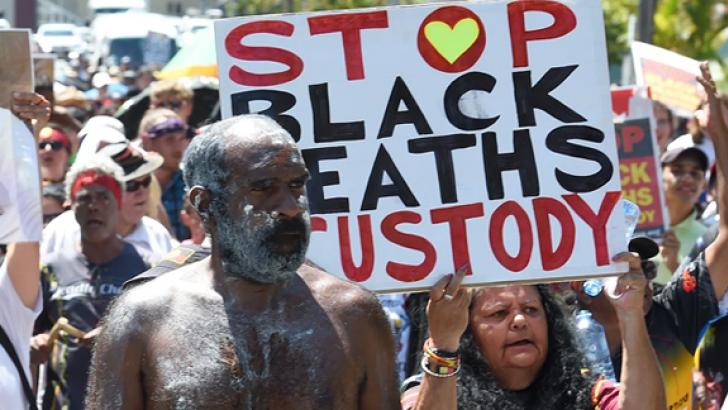
Ian and Carl play speeches from the death-in-custody rally last Saturday.

Speeches by Sam Watson, Fred Coolwell & Lionel Fogarty about black deaths in custody/police murder. Lionel Fogarty talks about terrorism against his people.

In the last 15 minutes of the show Carl talks about the Marxism 2016 Conference in Melbourne on the Easter Weeken 24 – 27 March. Guest speakers include Farah Kobaissy (Lebanon), Panos Petrou (Greece), Mandla Nkos (South Africa), & Ali Abunimah (Palestine).

Playlist
Black RageLauryn Hill

Sukamani – Aewon Wolf and Mashayabhuqe KaMamba

Fists like this – MC Tricks and Black Shield

__oOo__

Aboriginal protesters and their supporters marched on Queensland Police headquarters calling for justice for Shaun Coolwell, on Saturday 24 October. He is the latest fatality in an ongoing epidemic of Aboriginal deaths in custody.

On 2 October, Shaun was at home in Logan, south of Brisbane, observing the fourth anniversary of his brother Bradley Coolwell’s death in police custody. After a distressed Shaun hurt himself and was bleeding, the family called an ambulance. However, paramedics called the police. Witnesses reported seeing 10 to 12 police cars arrive.

“Shaun was smashed down onto the floor and they used their knees and shoulders to hold him and handcuffed his hands behind his back”, family spokesperson Sam Watson told the Brisbane Times. Instead of receiving immediate medical assistance, Shaun was assaulted by police. By the time he arrived at Logan Hospital was declared deceased.

At the demonstration, community leader Fred Coolwell addressed the massive contingent of police: “I’m getting sick and tired of coming here and putting my point across, to how disgusted I am with the Queensland Police Service. They can never do no wrong, yet they can run into a blackfulla’s home, kick the door down and do whatever they want”.

Another speaker, Tony Robertson, remarked, “I look around now and I don’t see any of my whitefulla friends in the Recognise campaign standing here in solidarity. That worries me”. [Carl Jackson from Red Flag]

Film and resistance in West Papua

Paradigm Shift 4zzz fm 102.1 23 Oct 2015

Wensi, Tali, Marcellino and Ian present show about filmmaking in West Papua as a form of struggle.

Important community announcement
But first Ian reports on the response to police murder of Shaun Coolwell, a young aboriginal man in his prime cut down by the Queensland Police Force.

No more police murder
SATURDAY 24TH. OCTOBER.
RALLY AT PARLIAMENT HOUSE AT 11AM.
MARCH ON THE POLICE HQ AT ROMA STREET
 

Indonesian security forces have never been held accountable for the brutal murders of free west papuaPapuans on the island of Biak in July, 1998. In the last 3 years, they have killed 29 unarmed, peaceful members of KNPB, an activist group in Papua. Since December last year, Indonesian security forces have killed at least 10 young unarmed and peaceful Indigenous Papuans. These killings are committed with total impunity and, yet, the Australian Government claims the human rights situation in West Papua is improving!

Ian talked about a West Papuan friend, Matthew Meyer, who was from Biak. In the 1970s Matthew Meyer was a member of West Papua’s One’s Peoples Army. Matthew spent years in exile here after  a lucky tip-off that he was to be deported from PNG back to West Papua and a likely death at the hands of the TNI Indonesia’s ruthless military, an occupation of West Papua that continues to this day. Matthew could often be seen on the steps of the Australian Government Centre protesting Australia’s engagement with Indonesia while our nearest neighbour was under military occupation. Wensi and Marcellino discuss how close to Australia West Papua is.

When will the killings stop? When will Australia and other countries stop funding and training the perpetrators of these killings? When will international action be taken to hold the Indonesian Government and its security forces to account for years of extra-judicial killings?

Listen to filmmaker Wensi talk about how he documents the campaign for justice for West Papua. Also this Sunday October 25, West Papuan film maker and human rights defender, Wensi Fatubun, will premiere his new documentary on a horrible chapter in the history of West Papua, the 1998 Biak massacre. The screening will take place at 11 a.m. in the Waterford Place Theatre, cnr Water & Quarry Streets, Spring Hill (on the grounds of St Joseph’s College, Gregory Terrace). Wensi will speak about his film and answer questions.

Tonight (23 October) 7pm screening of Wensi’s films outdoor cinema at Northey Street farm off Bowen Bridge Road.

This tragedy is not just a story from the past. Since December last year, 8 unarmed teenagers have been killed by Indonesian security forces in West Papua and no-one has been held accountable for their deaths.

Play List
‘Free West Papua’ by band from Vanuatu & Solomon islanders features Benny Wenda
Black Paradise – West Papua – Spirit of Mambesak – Aye Nanawe
Solidarity song from Biak

Film Showing - wensiYou Tube Channel: More Links

https://www.youtube.com/channel/UC6DlX6kQAOp-e0HjOfF3YBA

  *   Cybertribe Culture: http://cybertribe.culture2.org/theotherapt/2012/wensi.html
  *   New footage of West Papua massacre casts spotlight on military abuse (published by MRG): https://www.youtube.com/watch?v=Vs-p4lhHbDk
Papuan Voices project (www.papuanvoices.net<http://www.papuanvoices.net/&gt;)

  *   The Eyes of the Papuans: A video advocacy process: http://westpapuamedia.info/2015/04/27/the-eyes-of-the-papuans-a-video-advocacy-process/
  *   TV5Monde (Wensislaus Fatubun, premier cinéaste de Papouasie Occidentale): https://www.youtube.com/watch?v=h2E49WzS6cg

FB EVENT PAGE:
https://www.facebook.com/events/928261417239173/?ref_dashboard_filter=upcoming&action_history=null

Mental Health and the Public Trustee Exposed

[PShift 4ZZZ fm 102.1 Friday 16 Oct 2015]

Nathan and Nicole present radical perspectives on mental health.

Pls Note: your own perspective is important, this is an alternative view where self-determination is a key to change in mental health perspectives.

Jacks McNamara does interview on Icarus project with Ken Paul Rosenthal  and gives his own experiences.

See also – http://theicarusproject.net/

restreamerNicole  does interview with Rosslyn from the Qld Public Trustee Exposed who is trying to raise awareness on the perpetrators of bad decisions by the public trustee and guardian. Questionable financial decisions by the Public Trustee resulting in the denial of justice.

See also https://queenslandpublictrusteeexposed.wordpress.com/

Various community health announcements.

Playlist
Bonfire Madigan – Inch X Inch

12:09 Jacks McNamara – Crooked Beauty excerpt

Mental Health, Too Much Order & Not Enough Justice

[Paradigm Shift 4ZZZ friday 9 Oct 2015 at noon]

Nathan and Nicole present a show about mental health in the lead-up to World Mental Health Day tomorrow, 10th Oct 2015.

restreamerNathan speaks with Jo Bury about dealing with old age, sickness and loss of independence. Jo recommends that people live in the moment and be caring of other people.

Nicole and Nathan discuss euthanasia and raise the importance of giving people the right to decide when they are ready to go. Nicole suggests that we need to do a lot more about

Some tips
Elderly people may feel too much pride to seek help. There is blame placed on old people. It is important to know your neighbours and reach out.

Musgrave Park – a day out for people on Saturday, 10 Oct 2015. Wesley Mission phone – 18004937939

Andy does a report about over policing, racial profiling and Border Force in Victoria.

Playlist
Lifeline – CSA
Daniel Johnston – Don’t let the sun go down on your
Jo Bury – Interview

Is Punk Political?

Paradigm Shift (4zzz fm 102.1 fridays at noon) 2 Oct 2015.
Debra and Nicole critique the ABC doco ‘Stranded’ about punk music in Brisbane and around the world. Ian and Nicole discuss punks recruited to a revolutionary organisation and in the broader movement.

Playlist
christine johnson – the dream before
rivermouth – propaganda
the clash – know your rights
patti smith – ghost dance
the pogues – dirty old town

Tribute to Jagera man and to sovereignty

landRights2 copyParadigm Shift (4zzz fm 102.1 fridays at noon) 25 Sep 2015
A tribute to Kevin Vieritz, a proud Jagera  man.
Murrumu bedazzles Cairns court on the failings of the Australian constitution.
Announcer: Ian Curr
Photo: Brendon Qu

Vale Kevin Vieritz (1958 – 2015)
Introduction
I met Kevin in the last three years of his life. There is one important story I wish to tell; it is Kevin’s story for without him the fight to save the sacred fire that drew us into common cause would never have happened. While I knew him for only three years I learnt some important lessons from our struggle against the state and local government’s refusal to permit the sacred fire in Musgrave Park during that time.
As many would know Musgrave Park (named after an interloper, the Governor of Queensland, Sir Anthony Musgrave K.C.M.G. in 1884 ) has a special significance for aboriginal people and for residents and activists who have spent time there over the turbulent years of protest and open revolt against repressive Queensland governments since the 1960s … and before, since colonisation.
Before Brisbane became a British colony and before settlers began arriving in the 1830s, Musgrave Park was a different place. It had paper bark trees which is the more common tree found near rivers like the Brisbane. The Bunyas that are there now were planted later.
Before colonisation Musgrave Park was not a natural place, it was managed by Jagera people through the judicious use of fire to clear the undergrowth, it was an open and attractive place to meet; tribes from all points of the compass came there; there is evidence of a bora ring and no doubt corroborees were conducted there.
Conspiracy of Respect
I first met Kevin Vieritz in Musgrave Park in 2013. We drove to a petrol station in Milton to buy some wood. It was on that short trip over the Brisbane River and back that Kevin explained to me how important the sacred fire is to Jagera people, to all aboriginal people.
‘The sacred fire is lit and maintained so that those who gather around it can freely express themselves. The fire is used in our culture to burn away old and to bring in the new. The fire is cleansing because when people pass through the smoke it excludes bad things and bad thoughts.’ Kevin told me.
He described what he understood by cultural responsibility saying that it is something that a person takes on as an individual, you don’t go and talk with others about what needs to be done, you take on your responsibility and stand by it.
Kevin was true to these words.
From the 40th anniversary of the original tent embassy in 2012 onwards, state and local government enforced prohibitions on the sacred fire in Musgrave Park.
Kevin took on his responsibility to continue practicing his culture and defending the sacred fire in the face of considerable force exercised by the state to prevent aboriginal people from doing so. Over two hundred police attacked the sacred fire lit by the Brisbane Aboriginal Sovereign Embassy in March 2012. Thirty-five people were arrested.
On that trip to get wood for the fire Kevin told me his traditional name is Arjin Warrugar. He asked me to help him saying that if he were arrested lighting the fire that I should keep it going. I promised that I would help. I did so because I respected Kevin and because I respected his law regarding the sacred fire. Over the years I had participated in welcome and smoking ceremonies in Musgrave Park.   Effectively we were agreeing to break local laws together because of the prohibition on lighting the fire in Musgrave Park. We stuck to our plan and we stuck to each other despite arrest, fines and threats by council, police and court. Ours was a ‘conspiracy of respect’ for aboriginal custom, practised on Deed of Grant of Land in Trust (DOGIT) designated for aboriginal purpose and no other.
Resistance
On 29th and 30th April 2013, Kevin was arrested for defending the fire as was our friend Maurie. Kevin stood his ground and denied Brisbane City Council officers access to the fire telling them that it is sacred and that he was a traditional owner.
The fire was well maintained, secure and safe, having a firebreak around it. But council officers and police ignored what Kevin said and arrested him. A Kuku-Yalanji woman who was standing nearby told police and council officers that they had made a big mistake, that Kevin is a traditional owner implying that they should not ignore what Kevin said and show some respect.
At first police claimed Kevin was in ‘breach of the peace’, handcuffed him and took him away. Ironically, council officers gave me an infringement notice for lighting the fire that had actually been lit by Kevin. The infringement notice was given under the Health Safety and Amenity Local Law 2009. It was as if the charges against were contrived for our observance of the law, not for our breaking it.
Police and court imposed a condition of bail that Kevin should not return to Musgrave Park.
Denied the human right to walk on his ancestral lands and to practice his culture, Kevin would camp opposite Musgrave Park and not enter the park to avoid going to jail. Aboriginal kids would ask why Kevin was always in ‘naughty corner’. Kevin engaged a lawyer to help him fight his cases but a magistrate told this proud Jagera man that he would be jailed if he returned to Musgrave Park.
The magistrate made Kevin a refugee in his own country.
One day, prior to the bail condition being imposed, I saw Kevin standing quietly by the fire. I asked him what he was doing. He told me he was trying to get rid of angry thoughts. It seemed that by standing near the fire was a way to dispel negative emotions, a calming influence. Kevin was angry at what had been done to the land and to the original owners. On another occasion he explained to me that there were other places more sacred to Jagera people (than Musgrave Park). He told me about the beach at Kangaroo Point. Kevin explained that this was more sacred because it is where you could first see the morning sun, the beginning of each day.
Kevin spoke of legal strategies to gain recognition of sovereignty for his countrymen. He said that he had gone to Western Australia because he had heard how bad it was over there and that he wanted to take up a court case to challenge government’s refusal to recognise aboriginal sovereignty. However he returned saying the courts would not listen to him.
On the first anniversary of 35 arrests of people defending the fire, Kevin carried the smouldering ashes of the fire down to the lower part of Musgrave Park, thus beginning the traditional welcome ceremony and corroboree. He told me how heavy the burning piece of wood was to carry from the DOGIT land near Jagera Hall down to the area below.
Trial
After a long wait Kevin gave evidence in the trial about the sacred fire in the Brisbane Magistrates court. Magistrate Callaghan accepted his evidence in full stating:
“There was evidence from Mr Vieritz which I accept that the fire which he asked Mr Curr to light and maintain was a sacred fire in the culture of his people. Mr Vieritz explained that there are two types of fires. One is a communal fire and has significance for the family and community and the other type of fire is the sacred fire around which the truth is to be spoken. It is a place for seeking help and is a place where new ideas are borne.”
The magistrate used legal fiction to repudiate Kevin’s right to practice his culture by claiming that all are equal before the law.
It is a basic principle that all people should stand equal before the law. A construction which results in different criminal sanctions applying to different persons for the same conduct offends that basic principle (see Racial Discrimination Act 1975 (Cth), s 10). Chief Justice Mason in (Dennis) Walker v New South Wales [1994] 182CLR 45
The magistrate’s thinking was that if the local law imposes a criminal sanction on lighting a fire in Musgrave Park then there can be no exception that all must stand equal before the law. But there is no equality before the law, the magistrate acknowledged that himself stating:
If the prosecutions contentions that the lighting and maintaining of fires on this land were on 13 and 19 December 2012 prohibited by local law are correct then it would be difficult for them to maintain an argument that the purported permission given by the Lord Mayor to light the fire in May 2012 was lawful.
Or as Anatole France said with more than a little irony:
‘The poor have to labour in the face of the majestic impartiality of the law, which forbids the rich as well as the poor to sleep under bridges, to beg in the streets, and to steal bread.’
I suspect it is this injustice that made Kevin an angry man.
Yet, in my experience, he was always polite and did not direct his anger at others. He did not like bullies and stood his ground when police and council officers moved against him. He did not resist when police arrested and charged him with ‘Assault or Obstruct Police Officer’. Kevin was put through the indignity of handcuffing, body search, getting him to spread his legs and taking his few possessions including his tent and his mobile phone.
Eighteen months later when we finally got to court the magistrate found me guilty of lighting and maintaining the fire that Kevin had lit saying:
“ … the fact that he (Curr) is a non Aboriginal person acting on the instruction of or at the request of an Aboriginal elder (Vieritz) doesn’t assist the defendant’s argument.”

The magistrate did not impose a sentence or penalty yet he was at pains to pinpoint exactly why I was guilty and why I could not use Kevin’s permission to maintain the fire as an excuse:
The proposition that those laws could not apply to particular inhabitants or particular conduct occurring within the State must be rejected. As Gibbs J. (with whom Aickin J. agreed) said in Co v The Commonwealth ((1979) 53 ALJR 403 at p 408; 24 ALR 118 at p 129) ‘The Aboriginal people are subject to the laws of the Commonwealth and of the states or territories in which they respectfully reside’.
Magistrate Callaghan referred to the Queensland Constitution Act 1867 stating:
“ (The Act) provides that the legislative assembly can advise and consent to the Queen making laws for the peace, welfare and good government of the colony in all cases whatsoever and through the Land Act, the Local Government Act and the City of Brisbane Act the Brisbane City Council is empowered to make these by-laws which it is alleged the defendant has offended. As Mason CJ said as quoted above, the proposition that these laws could not apply to particular inhabitants or particular conduct occurring within the State must be rejected.
Kevin had finally got his day in court, but it had ruled against us. But in so doing the court was forced to acknowledge claims made by Kevin. The magistrate made this concession to Kevin:
Mr Vieritz gave evidence that the fire was a sacred fire, evidence which I accept. He said that ashes from the Canberra fires that had been lit outside the tent embassy there 40 years ago were used to light this one. He said he understood that there was a smoking ceremony when this fire was originally lit. He said the fire was significant. He said that even though the fire went out when the tents were cleaned out of the site, the fire had not been extinguished.
Sam Watson also gave evidence in the trial of the sacred fire that supported and expanded on Kevin’s statement to the court. The magistrate said this about Sam Watson’s evidence:
Mr Watson gave evidence that the fire was a sacred fire. Again I accept this evidence. He said though that the fire was more for symbolic value. I accept this evidence. The fire was a symbol of the protest that had been occurring in Canberra over the previous 40 years. It was a symbol of solidarity with that protest.
I know little of Kevin’s earlier life. He told me that he had a daughter who he had travelled with across the north of Australia and that she had got sick and they had to stop in Darwin. Kevin was a devoted son looking after his mother in her old age. They lived in a housing commission house in Inala. After she died Kevin lost the house and had to move into temporary accommodation. Eventually he rented a unit in Kent Street New Farm. I know that Kevin’s actions in support of his culture had the support of the Bonner and Carter families.

“This is a country very concerned about making things seem to happen without actually doing anything. They like to talk about progress, but that comes at a cost, and the cost is on us”

— Kevin Vieritz at first Sovereignty & Land Rights Conference in Brisbane in November 2012.

Farewell my brother, you have gone to your dreaming and we are the better for your efforts and leadership to save the sacred fire, your culture, our justice.
We will miss you.
Ian Curr
24 September 2015

__oOo__

Murrumu was held against his will in captivity some days before this interview for driving a car with Sovereign Yidindji number plates (gold plated). He was charged with six offences, including unlawful possession of an article resembling a licence and driving unlicensed and uninsured. When asked by magistrate Jane Bentley if he was Jeremy Geia, he said, ‘I am Murrumu’. He told the court that as a member of the Yidindji society, he was excluded from the Commonwealth Constitution Act of 1901. Murrumu was a couple of days in jail, but the Judge basically agreed he was not Jeremy Geia, his previous name, before he rescinded all contracts and handed back instruments such as his Australian passport, drivers license, car registration papers and super fund entitlement. The magistrate, Robert Spencer is reported to have said: “I’ll take it on that basis that effectively you are not Jeremy David Joseph Geia” and let Murrumu go free and Murrumu has said he will thank him for this.

  • Bec Horridge
    WGAR News

Return – a Palestinian memoir

Interview by Ian Curr for the Paradigm Shift (4ZZZ fm 102.1 Fridays at Noon) 4 Sept 2015

Q 1. In the book Return you describe brutal response by the British army to the Arab Revolt in 1940s which was a “three-year general strike and mass revolt against British rule” … yet your family ended up living in London and in the Jewish neighbourhood of Golders Green and you went to school with Jewish girls – please explain how this came about?

__oOo__

Q 2. You describe yourself as ‘a full-time Palestinian’ yet in Chapter 1 titled Journey to Ramallah you say:

“I had sworn never to return to this torn-up, unhappy land after that first trip in 1991 when I broke a long-standing family taboo against ever visiting the place that had been Palestine and then became Israel. ”

How do you explain these contradictory feelings?

__oOo__

Q 3. You describe a meeting you had with Palestinian poet Mahmoud Darwish who said of the Palestinians:

“We travel like other people, but we return to nowhere … we have a country of words”

Is Palestine more than a country of words? What makes it so?

__oOo__

Q 4. What did your family lose when you fled to Damascus in 1948?

__oOo__

Q 5. You are travelling with this new book Return and doing speaking engagements, which you would have done with previous books like In Search of Fatima: A Palestinian Story.

Have people’s perceptions of the struggle of the Palestinian people for justice changed? How so?

Is this change due to the relentless Israeli bombing of Gaza and the international criticism that has followed?

I refer to the recent Israeli bombing of Gaza in 2014 where 2,251 people including 551 children were killed?

__oOo__

Q 6. I was touched when reading your book by the Chapter where you refer to a personal connection you had with a Palestinian woman, Fatima al Basha … these are in the years leading up to al Nakba in 1948 when you were nine years old.

Can you describe the relationship you had with Fatima and subsequent events?

__oOo__

I would like to ask some political questions, if I may, because not only are you an author but you have been a commentator on the political events surrounding the Palestinian struggle for many years.

Q 7. After the Oslo Peace agreement in 1993 the Palestine Liberation Organisation returned to Palestine after many years in exile. It first went to Gaza and then to Ramallah on the West Bank as you describe in your book.

In ‘Return’, you hold up the PLO as the representative of the people in exile, it was the PLO that gave you a sense of purpose.

After the death of Yasser Arafat in 2004, you went to Ramallah as a consultant to the Palestinian Authority which had policed its own people opposing the settlements all over the West Bank and entered into deals with the Americans and with Israel.

Why did you do that?

__oOo__

Q 8. In 2005 a broad cross-section of Palestinian civil society called for a campaign of Boycotts Divestments and Sanctions against Israel, do you support the BDS campaign?

__oOo__

Q 9. Thank you for agreeing to do this interview. Is there anything you would like to add?

__oOo__

We shall return
the nightingale told me
when we met on a hill
that nightingales still
live there on our dreams
and that among the yearning hills
and people there is a place for us
O heart then
how long has the wind scattered us.
Come, we shall return
let us return.

Sanarjou Yawman – فيروز – سنرجع يوما
sung by Fairfous

Playlist
Phil Monsour – 100 Days info
The Firedrakes – My brother’s keeper
Fairouz – We will return one day
United Struggle Project – Liberate yourself
Michelle Cinthio feat. DAM – Oh Gaza

Anzac Day Terror Plot

[Paradigm Shift 4zzz fm 102.1 24 Aug 2015]

Andy interviews Jessie from Starry Lawyers and Ali Kadri from the Islamic Council of Queensland about the dropping of charges for lack of evidence against 18 year man, Harun Causevic.

They discuss the hype shown by the government in claiming that police were to be run down and people were to be executed by radical Islamists.

Andy discusses media character assassination.

Playlist
Bridge And Tunnel – Wartime souveneirs
Golden Orb – Ghost gum
Run Pig Run – Scream
Bad Day Down – Deus ex machina